
Aquarium of the Pacific - A Non-profit Organization
Today's Hours: 9:00 am – 6:00 pm

Group Education Programs

Enhance your group’s visit to the Aquarium by adding an additional education program. Programs are available for K-12 and adult learners.

Book Your Field Trip Now
(562)590-3100, ext 0.

20250304-AOP_AR-0526w.jpg

Dive deeper by booking a program led by an Aquarium educator. Perfect for Expanded Learning, after school groups, scout groups, and more!

Programs are add-ons and do not include Aquarium admission. Please visit the Group sales or Expanded Learning page for admission details.

Book Your Field Trip Now
(562) 590-3100, ext. 0

List of programs

Animal Exploration
Grades K-12 and Adult (up to 35 participants, 20 minimum.)

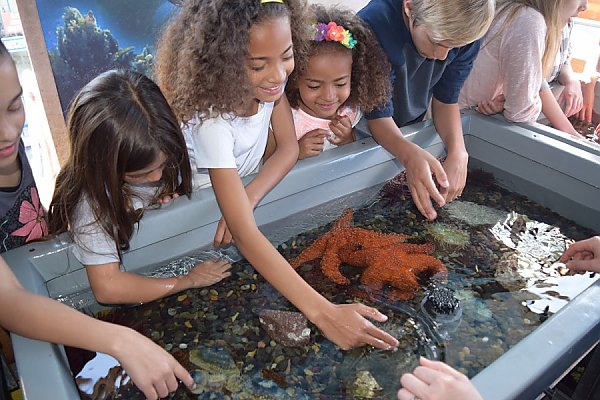
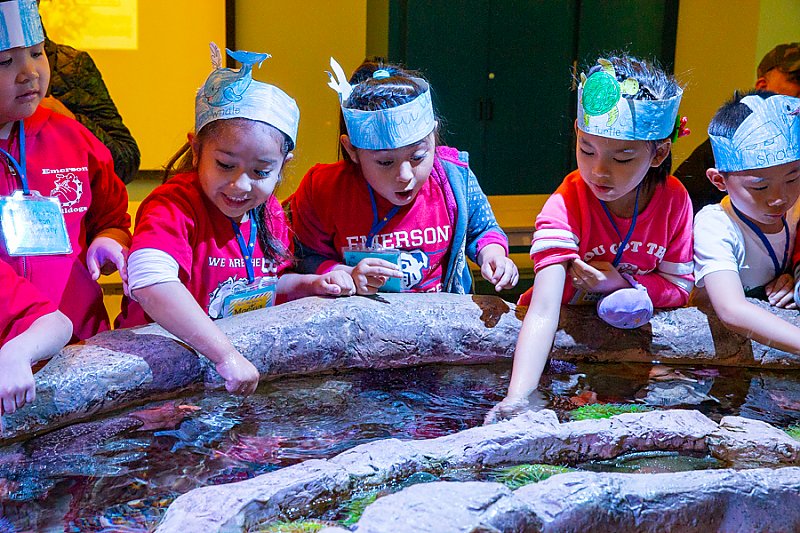
Get your hands wet in this 30-minute, educator-led animal exploration class.

After a brief introduction, students will touch and explore live tidepool animals, animal models, and biofacts.

  • Supports Next Generation Science Standards:
    • Science and Engineering Practices
      • Asking Questions and Defining Problems
      • Engaging in Argument from Evidence
    • Cross Cutting Concepts
      • Patterns

Aquarium Exploration
Grades K-12th and Adult (Up to 70 participants, 20 minimum)

Explore some of the amazing animals found in coral reefs and kelp forests.

Learners will compare living and non-living elements of tropical and kelp forest habitats.

  • Supports Next Generation Science Standards:
    • Science and Engineering Practices
      • Asking Questions and Defining Problems
      • Engaging in Argument from Evidence
    • Cross Cutting Concepts
      • Patterns

Predator!
Grades 3-8 (Up to 35 participants, 20 minimum)

Ocean predators come in all shapes and sizes and use special adaptations for hunting.

Learners will use hands-on activities to investigate a variety of predators and their important roles in ocean food webs.

  • Supports Next Generation Science Standards:
    • Performance Expectations
      • 3-LS4-3. Construct an argument with evidence that in a particular habitat some organisms can survive well, some survive less well, and some cannot survive at all
      • 4-LS1-1. Construct an argument that plants and animals have internal and external structures that function to support survival, growth, behavior, and reproduction.
      • MS-LS2-2. Construct an explanation that predicts patterns of interactions among organisms across multiple ecosystems.
      • MS-LS2-4. Construct an argument supported by empirical evidence that changes to physical or biological components of an ecosystem affect populations
    • Disciplinary Core Ideas
      • LS1.B: Growth and Development of Organisms
      • LS2.A: Interdependent Relationships in Ecosystems
    • Science and Engineering Practices
      • Asking Questions and Defining Problems
      • Engaging in Argument from Evidence
      • Analyzing and Interpreting Data
      • Developing and Using Models
    • Cross Cutting Concepts
      • Patterns
      • Structure and Function

Sensational Sharks
Grades 3-8 (Up to 70 participants, 20 minimum)

Discover all that is sensational about sharks!

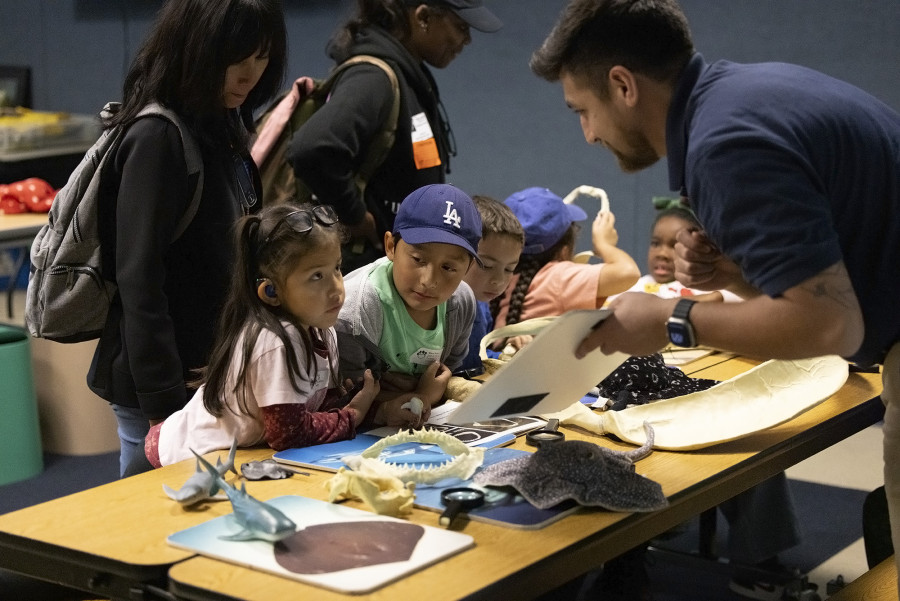
Learners will explore these fascinating animals, learning what sets sharks, a type of fish, apart from other fish in the ocean. Using live view from the aquarium shark webcams and artifact exploration, students will take a deep dive into the world of sharks, investigating their unique adaptations, including body structure, senses, and shark teeth.

  • Supports Next Generation Science Standards:
    • Performance Expectations
      • 3-LS4-3. Construct an argument with evidence that in a particular habitat some organisms can survive well, some survive less well, and some cannot survive at all
      • 4-LS1-1. Construct an argument that plants and animals have internal and external structures that function to support survival, growth, behavior, and reproduction.
      • 5-ESS3-1. Obtain and combine information about ways individual communities use science ideas to protect the Earth’s resources and environment
      • MS-LS2-4. Construct an argument supported by empirical evidence that changes to physical or biological components of an ecosystem affect populations
    • Science and Engineering Practices
      • Asking Questions
      • Engaging in Argument from Evidence
      • Constructing explanations
    • Disciplinary Core Ideas
      • LS4.C: Adaptation
      • ESS3.C: Human Impacts on Earth Systems

A Look Inside a Squid
9-12 & Adult (Up to 35 participants, 20 minimum)

How does a squid swim? Why does a squid ink?

The answers to these questions and many more can be found with a closer look inside the squid. This hands-on dissection program allows students to closely explore squid anatomy and discover the ins and outs of these interesting ocean animals.

  • Supports Next Generation Science Standards:
    • Performance Expectations
      • MS-LS1-3. Use argument supported by evidence for how the body is a system of interacting subsystems composed of groups of cells
    • Disciplinary Core Ideas
      • LS1.B: Growth and Development of Organisms
      • LS1.D: Information Processing
      • LS4.A: Evidence of Common Ancestry and Diversity
    • Science and Engineering Practices
      • Asking Questions and Defining Problems
      • Engaging in Argument from Evidence
      • Analyzing and Interpreting Data
    • Cross Cutting Concepts
      • Patterns
      • Systems and System Models
      • Structure and Function
      • Scale, Proportion, and Quantity

Conservation in Action
9-12 and Adult (Up to 35 participants, 20 minimum)

Be a conservation biologist while exploring efforts to conserve endangered Southern California wildlife most threatened by climate change.

In this class, learners will collaborate to design solutions for raising and releasing endangered species. Students will build a 3-D model to visualize and evaluate their ideas using real-world considerations and conservation plans currently in action.

  • Supports Next Generation Science Standards:
    • Performance Expectations
      • MS-ETS1-1. Define the criteria and constraints of a design problem with sufficient precision to ensure a successful solution, taking into account relevant scientific principles and potential impacts on people and the natural environment that may limit possible solutions.
      • o HS-ETS1-3. Evaluate a solution to a complex real-world problem based on prioritized criteria and trade-offs that account for a range of constraints, including cost, safety, reliability, and aesthetics, as well as possible social, cultural, and environmental impacts.
    • Science and Engineering Practices
      • Asking Questions and Defining Problems
      • Constructing Explanations and Designing Solutions
      • Engaging in Argument from Evidences
      • Developing and Using Models
    • Disciplinary Core Ideas
      • SS3.C: Human Impacts on Earth Systems
      • LS2.A: Interdependent Relationships in Ecosystems
      • LS2.C: Ecosystem Dynamics, Functioning, and Resilience
      • LS4.D: Biodiversity and Humans
      • ETS1.B: Developing Possible Solutions
    • Cross Cutting Concepts
      • Patterns
      • Stability and Change
      • Science is a Human Endeavor

Kelp Forest Conservation
Grades 9-12 and Adult (Up to 70 participants, 20 minimum)

Kelp Forests are a unique and productive habitat local to Southern California, but are also one of the most threatened by climate change.

Students will learn about the kelp forest ecosystem, why it’s important, threats, and ways we are helping these habitats recover.

  • Supports Next Generation Science Standards:
    • Performance Expectations
      • MS-ESS3-4 Construct an argument supported by evidence for how increases in human population and per-capita consumption of natural resources impact Earth’s systems.
      • MS-LS1-6. Construct a scientific explanation based on evidence for the role of photosynthesis in the cycling of matter and flow of energy into and out of organisms.
      • MS-LS2-3. Develop a model to describe the cycling of matter and flow of energy among living and nonliving parts of an ecosystem.
      • MS-LS2-4. Construct an argument supported by empirical evidence that changes to physical or biological components of an ecosystem affect populations
      • HS-LS2-6. Evaluate the claims, evidence, and reasoning that the complex interactions in ecosystems maintain relatively consistent numbers and types of organisms in stable conditions, but changing conditions may result in a new ecosystem.
    • Science and Engineering Practices
      • Asking Questions
      • Analyzing and interpreting data
      • Constructing explanations
      • Engaging in Argument from Evidence
    • Disciplinary Core Ideas
      • SS3.C: Human Impacts on Earth Systems
      • LS2.A: Interdependent Relationships in Ecosystems
      • LS2.B: Cycles of Matter and Energy Transfer in Ecosystems
      • LS2.C: Ecosystem Dynamics, Functioning, and Resilience
    • Cross Cutting Concepts
      • Patterns
      • Cause and Effect
      • Stability and Change

Field Trips to the Aquarium

Reservations & Info • (562) 590-3100, ext. 0

  • Provide opportunities to touch animals including sharks, sea stars, anemones, and more
  • Engage and excite students
  • Inspire awe in the Pacific Ocean and the animals that live there
  • Connect to classroom curriculum
  • Require advanced reservation

Aquarium Discounts

Discount tickets available at Ralphs for a limited time.