Western Snowy Plover
Anarhynchus nivosus nivosus

Western Snowy Plover
Anarhynchus nivosus nivosus
Maintaining a stable population of western snowy plovers requires protecting beach nesting sites.
Morphology
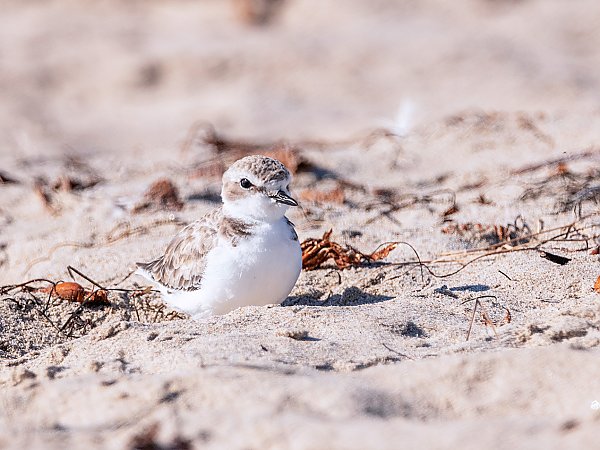
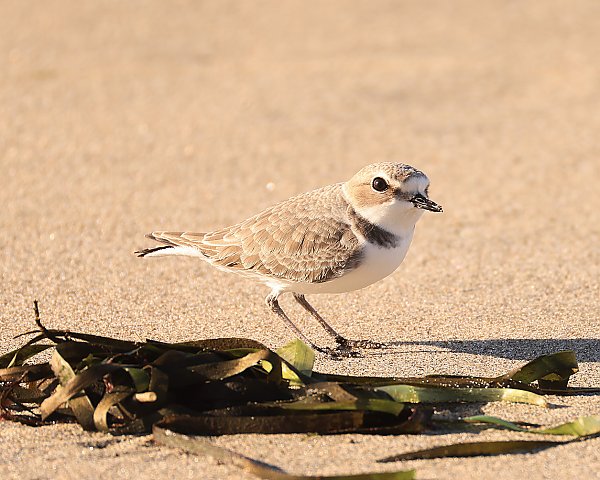
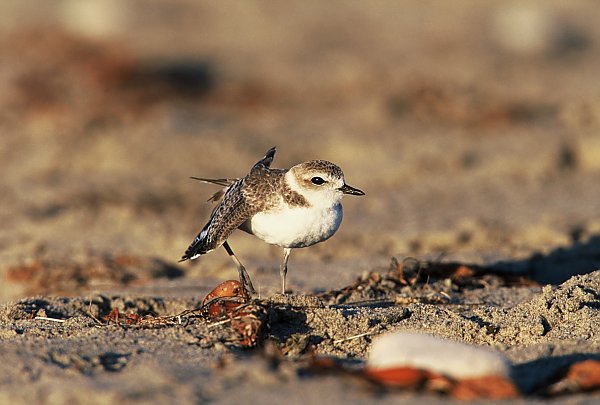
The western snowy plover is a small shorebird with long legs, a short neck, and a pale tan back with white underparts. The snowy plover’s distinctive coloring provides excellent camouflage on beach sands. Their egg coloration also matches beach sand or barren soil. Snowy plovers have large eyes and acute vision, which allows them to feed both during the day and at night.
Habitat and Range
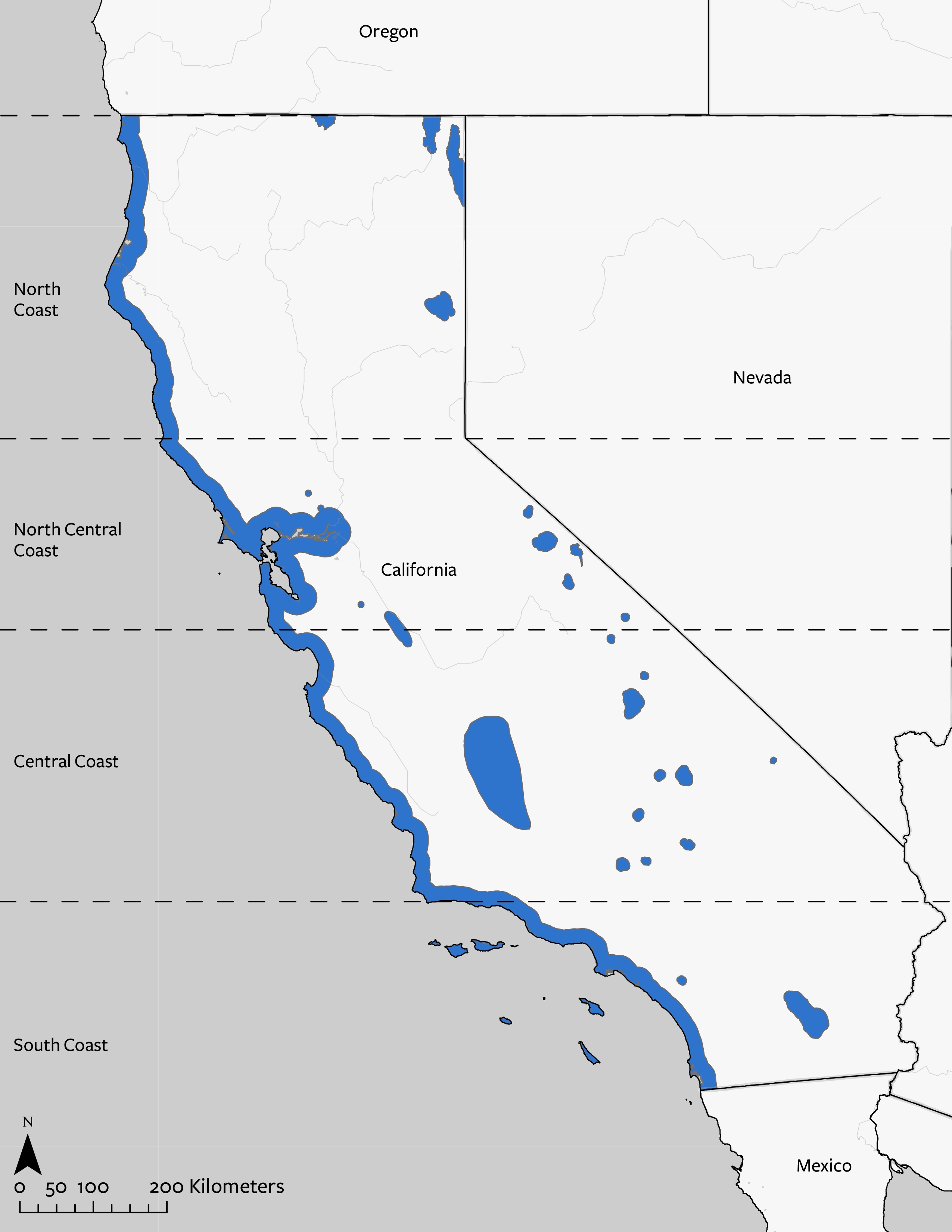
Snowy plovers are primarily found in open, sandy areas adjacent to water. The western snowy plover which is federally listed as threatened under the Endangered Species Act is defined as those individuals that nest on the mainland coast, peninsulas, offshore islands, bays, estuaries, or rivers of the United States Pacific coast. Their favored habitats include ocean beaches and barrier islands, gravel or sand bars in rivers, and reservoir margins. While some populations are migratory, others are year-round residents in coastal areas. The western snowy plover has a breeding range starting on the coast of Southern Washington down to Baja California.
Range Map
Reproductive Biology and Life History
Snowy plovers have a unique breeding system characterized by polyandry, where females may mate with multiple males in a season. The males typically tend to the chicks. Females typically desert their mates and broods after hatching to start a new nest and new “family” with a different male, sometimes repeating this 2-3 times in a season. Snowy plovers create shallow scrapes or depressions in the ground for their nests, often near conspicuous features like kelp or shells. The nests are camouflaged and difficult to spot, even for trained observers. Snowy plover chicks are precocial, meaning they are able to leave the nest within hours of hatching. They can walk, run, and swim well, and begin foraging independently almost immediately. However, they still require periodic brooding and protection for many weeks after hatching. Young birds usually become reproductively mature within one year of age. Lifespans are short – averaging less than five years.
Ecology
These birds are active foragers, primarily eating invertebrates such as: insects (beetles, flies, brine fly larvae), crustaceans (juvenile mole crabs, amphipods), mollusks (snails, clams), and polychaete worms. Plovers occasionally use a foot shuffling technique to stir up prey in the sand beneath their feet. Predators of snowy plovers include falcons, red fox, coyotes, owls. In addition, human-associated predators such as crows, racoons, ravens and domestic dogs can take their toll on snowy plovers. Snowy plovers are often seen using a broken-wing display to distract potential predators away from their nests or chicks. When a threat is detected, the plover will move away from the nest while vocalizing and dragging one wing along the ground, appearing injured. This display is designed to make the plover seem like an easy target, luring the predator away from the nest or young. It can be highly effective.
Cultural Significance and Historical Context
Prior to the 20th century development of California, snowy plovers were common on the beaches, bays and estuaries of the Golden State. However, human coastal development is a threat to snowy plover nesting and reproductive success, and the population suffered severe declines throughout the state. Finally, in 1993 the western snowy plover was listed as a threatened species under the federal Endangered Species Act. The plover’s dramatic decline highlighted for the public a need for beach conservation efforts and brought the species to the forefront of California’s environmental concerns. It had become clear that the increased beach recreational activities of the 1960’s and 1970’s needed to be contained and that free access to nesting sites for snowy plovers needed to be restricted. The nexus of a booming California human population with declining snowy plover populations led to the concept of “sharing our beaches”, which is now a central principle underlying snowy plover conservation.
Date modified: January 2025
This animal can be found at the Aquarium of the Pacific
Primary ThreatsPrimary Threats Conditions
Threats and Conservation Status
Human presence, especially when accompanied by dogs, can cause snowy plovers to abandon their nests or chicks. The sight of a dog, leashed or unleashed, can frighten adult plovers into leaving their nests or young. Even if the adults are only temporarily away from their nests, the energy cost of being disturbed can still reduce survival. Protections such as seasonal closures of nesting sites have helped snowy plover populations across the state stay stable with fluctuations at low numbers. However, there is likely a need for fencing off more nesting areas, educating beachgoers, and implementing stricter regulations on beach use during breeding seasons. Even with expanded protections, recovery of the snowy plovers to past levels may never be possible because of coastal development that cannot be totally undone.
There do appear to be regional differences in snowy plover population trends such that the North Coast region of California has recently exhibited an annual 6% increase, which explains 48% of the year-to-year variation in snowy plover counts, whereas other regions do not show this increase. Unfortunately, the Northern California increase appears to be primarily due to immigration from other sites and not due to sustainable reproductive success.
Population Plots
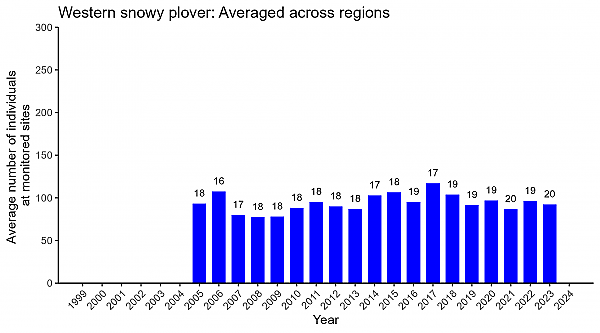


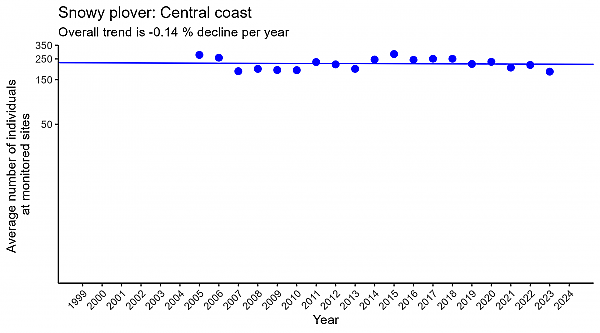


Data Source: U.S. Fish and Wildlife Service and Point Blue Conservation Science
- Colwell, M. A., Feucht, E. J., Lau, M. J., Orluck, D. J., McAllister, S. E., & Transou, A. N. (2017). Recent snowy plover population increase arises from high immigration rate in coastal northern California. Wader Study, 124(1), 000-000.
- Hardy, M. A., & Colwell, M. A. (2012). Factors influencing Snowy Plover nest survival on ocean-fronting beaches in coastal northern California. Waterbirds, 35(4), 503-656.
- Lafferty, K. D., Goodman, D., & Sandoval, C. P. (2006). Restoration of breeding by snowy plovers following protection from disturbance. Biodiversity & Conservation, 15, 2217-2230.
- Mullin, S. M., Colwell, M. A., McAllister, S. E., & Dinsmore, S. J. (2010). Apparent survival and population growth of Snowy Plovers in coastal northern California. The Journal of Wildlife Management, 74(8), 1792-1798.
- Neuman, K. K., Page, G. W., Stenzel, L. E., Warriner, J. C., & Warriner, J. S. (2004). Effect of mammalian predator management on Snowy Plover breeding success. Waterbirds, 27(3), 257-263.
- Page, G.W., Stenzel, L.E. and Ribic, C.A., 1985. Nest site selection and clutch predation in the Snowy Plover. The Auk, 102(2), pp.347-353.
- Ruhlen, T.D., Abbott, S., Stenzel, L.E. and Page, G.W., 2003. Evidence that human disturbance reduces Snowy Plover chick survival. Journal of Field Ornithology, 74(3), pp.300-304.
- Stenzel, L.E., Warriner, J.C., Warriner, J.S., Wilson, K.S., Bidstrup, F.C. and Page, G.W., 1994. Long-distance breeding dispersal of snowy plovers in western North America. Journal of Animal Ecology, pp.887-902.
- Stenzel, L.E., Page, G.W., Warriner, J.C., Warriner, J.S., George, D.E., Eyster, C.R., Ramer, B.A. and Neuman, K.K., 2007. Survival and natal dispersal of juvenile Snowy Plovers (Charadrius alexandrinus) in central coastal California. The Auk, 124(3), pp.1023-1036.
- USFWS. 2007. Recovery plan for the Western Snowy Plover. https://westernsnowyplover.org/pdfs/WSP%20Final%20RP%2010-1-07.pdf
- Warriner, J.S., Warriner, J.C., Page, G.W. and Stenzel, L.E., 1986. Mating system and reproductive success of a small population of polygamous Snowy Plovers. The Wilson Bulletin, pp.15-37.