Purple Sea Urchin
Strongylocentrotus purpuratus

Purple Sea Urchin
Strongylocentrotus purpuratus
Purple urchins have undergone a recent population explosion due to a wasting disease that ravaged populations of sunflower sea stars, which had been major urchin predators.
Morphology
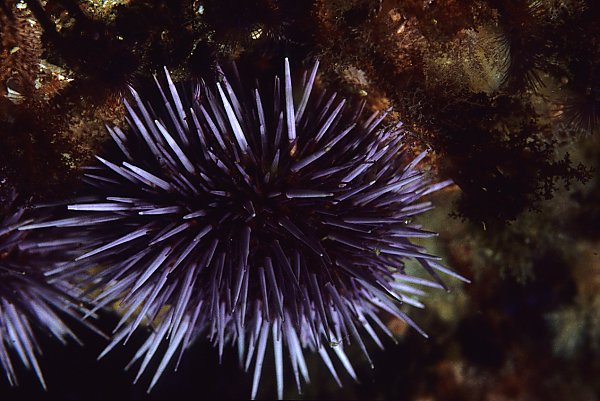
Purple sea urchins have a round, radially symmetrical body that can grow up to 10 centimeters in diameter. They are covered with bright purple spines that serve as protection, help with movement, and trap floating algae for consumption. Tube feet with suction cups cover their underside and also help with locomotion as well as with respiration and sensory perception. Urchins are equipped with an unusual structure called Aristotle’s Lantern, which is a unique mouth that consists of five bony plates or teeth, allowing the urchin to scrape algae off rocks. Using Aristotle’s Lantern and their spines, purple urchins can actually wear away depressions in intertidal rocks, which provides some protection from predators and environmental stresses.
Habitat and Range
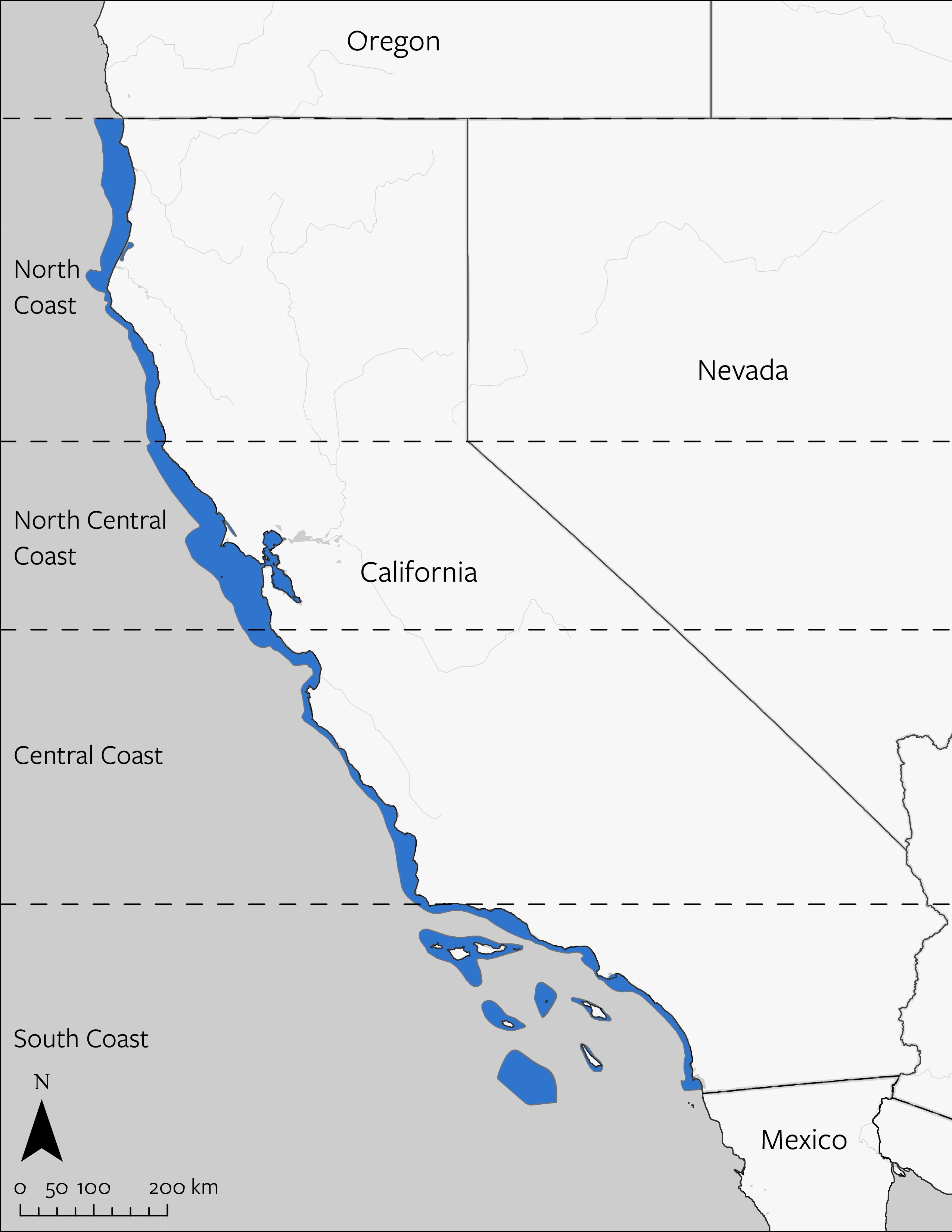
The purple sea urchin is found along the California coast, with a range extending from Alaska to Baja California, Mexico. Purple sea urchins inhabit the low intertidal and shallow subtidal zones, to depths of up to 100 meters, though they are most abundant in shallow waters.
Range Map
Reproductive Biology and Life History
Purple sea urchins have separate male and female individuals. However, distinguishing between the sexes is challenging because they are very similar in appearance. Female purple sea urchins release several million eggs during a spawning event, although only a small percentage (10% to 40%) are successfully fertilized by the male sperm. There is no parental care provided; the larvae feed and develop independently in the open water before settling and growing into adults. Purple sea urchins rely on high fecundity and external fertilization to maintain their populations. Their long lifespan and ability to reproduce annually make them a resilient species, although they are sensitive to changes in their ecosystem, such as the availability of predators and the health of kelp forests. Purple sea urchins reach sexual maturity at 1 to 2 years and can live for at least 20 years.
Ecology
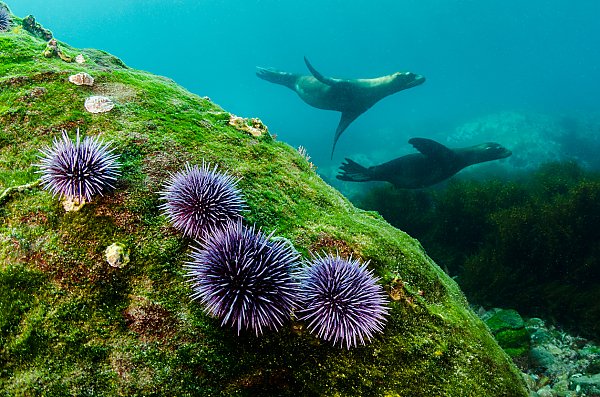
Purple sea urchins play a crucial role in kelp forest ecosystems as grazers, feeding primarily on kelp and other algae. When urchin populations are in balance, they help maintain kelp forest health by consuming drift kelp and controlling algal growth. Recent studies suggest that purple urchins possess ample genetic variation for resilience in the face of ocean acidification, and can rapidly adapt to changing ocean conditions through altered gene expression. They are also able to survive prolonged periods of starvation. Although typically solitary, purple sea urchins will cluster together for protection against predators and environmental elements. During low tide, they also often cover themselves with shells, rocks, and algae to protect against predators and UV rays.
Cultural Significance and Historical Context
Purple sea urchins have been a staple in the diets of various Indigenous tribes, including those in the Northwest Coast and California for hundreds of years. The gonads of the urchins, often referred to as “uni,” are considered a delicacy and were traditionally consumed raw or cooked. Beyond their nutritional value, purple sea urchins were also believed to possess medicinal properties. The collection and distribution of sea urchins were often communal activities that reinforced social bonds within tribes. For instance, some groups would gather large quantities to share among community members, while others might trade or sell them.
When it comes to commercial use, purple sea urchins have been harvested on a limited basis as an adjunct to the more lucrative red sea urchin fishery. Their roe is considered similar in quality to some desirable Japanese species and is sought after in Mediterranean countries. However, the amount of roe in purple urchins is highly variable and can be virtually nonexistent in urchin barren regions because there is no food for the urchins. In California, commercial harvesting of purple sea urchins requires a permit. The regulations for harvesting purple urchins are less stringent than those for red urchins, with no minimum size limits or closed periods.
Date modified: January 2025
This animal can be found at the Aquarium of the Pacific
Primary ThreatsPrimary Threats Conditions
Threats and Conservation Status
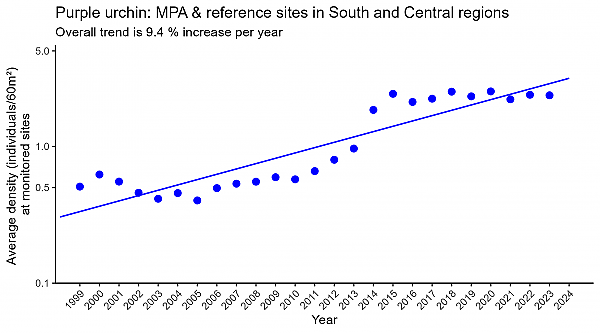
Purple sea urchin populations have exploded in recent years, with some areas seeing increases of up to 1,000%, a strong increase trend. This population boom has led to severe overgrazing of kelp forests along the Pacific coast. The destruction of kelp habitats has far-reaching ecological consequences, affecting numerous marine species that depend on these underwater forests. The urchin explosion is partly attributed to the decline of natural predators, most notably sea otters decimated by fur trappers, and sunflower sea stars ravaged by sea star wasting disease. Marine heatwaves have also contributed to kelp forest declines, exacerbating the effects of urchin overgrazing. This makes purple sea urchins both a threat to and a victim of changing ocean conditions. It is not yet clear whether or not marine heatwaves have a direct impact on purple urchins. The purple sea urchin presents a unique conservation challenge where overpopulation threatens kelp forest ecosystems. Simultaneously, emerging commercial interests in harvesting these urchins could potentially help mitigate their ecological impact. Balancing conservation needs with sustainable harvesting practices will be crucial for managing purple sea urchin populations and preserving the health of coastal marine ecosystems.
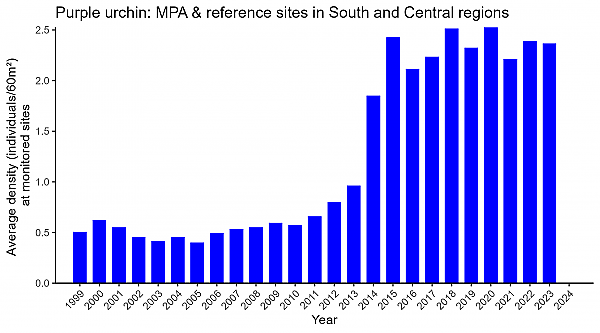
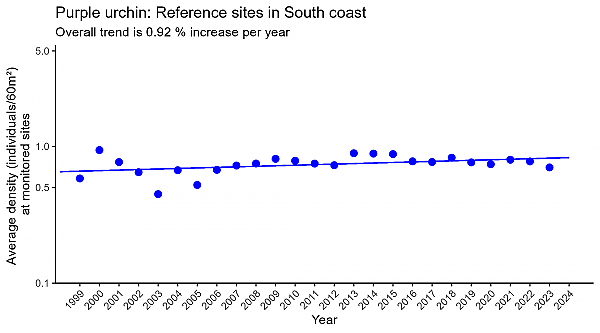
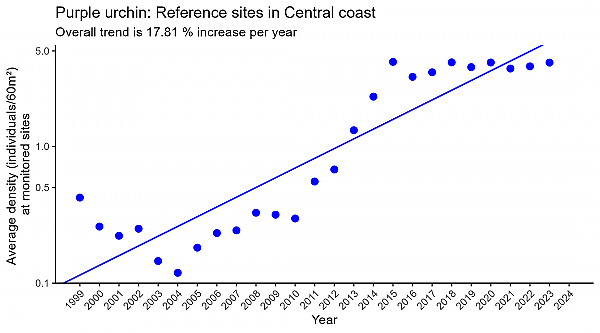
As can be seen below, the dramatic increase in urchin populations began in 2014 which coincides with the collapse of sunflower sea stars from 2013 to 2014. While the general statewide trend is one of increasing purple urchin density, differences exist between the regions, with the Central Coast region showing the greatest increase and the North Coast region being essentially stable over the last decade.
Population Plots
Data Source: Monitoring and Evaluation of Kelp Forest Ecosystems in the MLPA Marine Protected Area Network. California Ocean Protection Council Data Repository. doi:10.25494/P6/MLPA_kelpforest.7. Mark H Carr, Jennifer E Caselle, Brian N Tissot, Daniel J Pondella, Daniel P Malone, Kathryn D Koehn, Jeremy T Claisse, Jonathan P Williams, Avrey Parsons-Field, & Sean F Craig. (2024).
- Ainis, A. F., Erlandson, J. M., Gill, K. M., Graham, M. H., & Vellanoweth, R. L. (2019). The potential use of seaweeds and marine plants by Native peoples of Alta and Baja California. An archaeology of abundance: reevaluating the marginality of California’s islands. Gainesville: University Press of Florida, 135-70.
- Garrett, A. D., Brennan, R. S., Steinhart, A. L., Pelletier, A. M., & Pespeni, M. H. (2020). Unique genomic and phenotypic responses to extreme and variable pH conditions in purple urchin larvae. Integrative and Comparative Biology, 60(2), 318-331.
- Hamilton, S, Saccomanno, V., et al. 2021. Disease-driven mass mortality event leads to widespread extirpation and variable recovery potential of a marine predator across the eastern Pacific. Proc. R. Soc.
- Kelly, M. W., Padilla‐Gamiño, J. L., & Hofmann, G. E. (2013). Natural variation and the capacity to adapt to ocean acidification in the keystone sea urchin S trongylocentrotus purpuratus. Global change biology, 19(8), 2536-2546.
- Lafferty, K. D., & Kushner, D. (2000, January). Population regulation of the purple sea urchin, Strongylocentrotus purpuratus, at the California Channel Islands. In Fifth California Islands Symposium (Vol. 99, p. 0038). Minerals Management Service.
- Nichols, K. D., Segui, L., & Hovel, K. A. (2015). Effects of predators on sea urchin density and habitat use in a southern California kelp forest. Marine Biology, 162, 1227-1237.
- Pearse, J. S. (2006). Ecological role of purple sea urchins. Science, 314(5801), 940-941.
- Rogers-Bennett, L. and C.A. Catton 2019. Marine heat wave and multiple stressors tip bull kelp forest to sea urchin barrens. Scientific Reports 9: doi.org/10.1038/s41598-019-51114-y
- Rogers-Bennett, L., and C.A. Catton 2022. Cascading Impacts of a Climate-Driven Ecosystem Transition Intensifies Population Vulnerabilities and Fishery Collapse. Frontiers in Climate, Ecology and People, Special Issue: Advances in Marine Heatwave Interact
- Rogers-Bennett, L., Yang, G., and Mann J.A. 2022. Using the Resist-Accept-Direct management framework to respond to climate driven transitions in marine ecosystems. Fisheries Management and Ecology 29: 409-422. https://doi.org/10.1111/fme.12539.
- Rogers-Bennett, L., Klamt, R., C.A. Catton 2021. Survivors of climate driven abalone mass mortality exhibit declines in health and reproduction following kelp forest collapse. Frontiers in Marine Science: Global Change and the Future Ocean. 8: https://doi
- Sato, K. N., Powell, J., Rudie, D., & Levin, L. A. (2018). Evaluating the promise and pitfalls of a potential climate change–tolerant sea urchin fishery in southern California. ICES Journal of Marine Science, 75(3), 1029-1041.
- Scarborough, C., Welch, Z. S., Wilson, J., Gleason, M. G., Saccomanno, V. R., & Halpern, B. S. (2022). The historical ecology of coastal California. Ocean & Coastal Management, 230, 106352.
- Tegner, M. J., & Dayton, P. K. (1991). Sea urchins, El Ninos, and the long term stability of Southern California kelp forest communities. Marine ecology progress series. Oldendorf, 77(1), 49-63.