Owl Limpet
Lottia gigantea

Owl Limpet
Lottia gigantea
Although owl limpets are common in some areas, they remain at risk of being unsustainably harvested.
Morphology
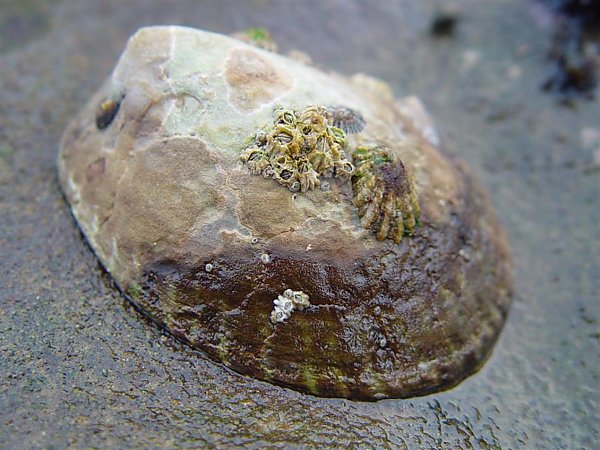
Owl limpets are marine mollusks that make their living in the rocky intertidal by grazing on microalgae. They are the largest limpets in North America and can reach sizes up to 10 centimeters in length. The exterior of the shell is usually light brown with whitish spots. The owl limpet has a strong muscular foot that it uses for locomotion and to hold on to rocks. Limpets have a radula or ribbon of teeth that they use to scrape algae off rocks.
Habitat and Range
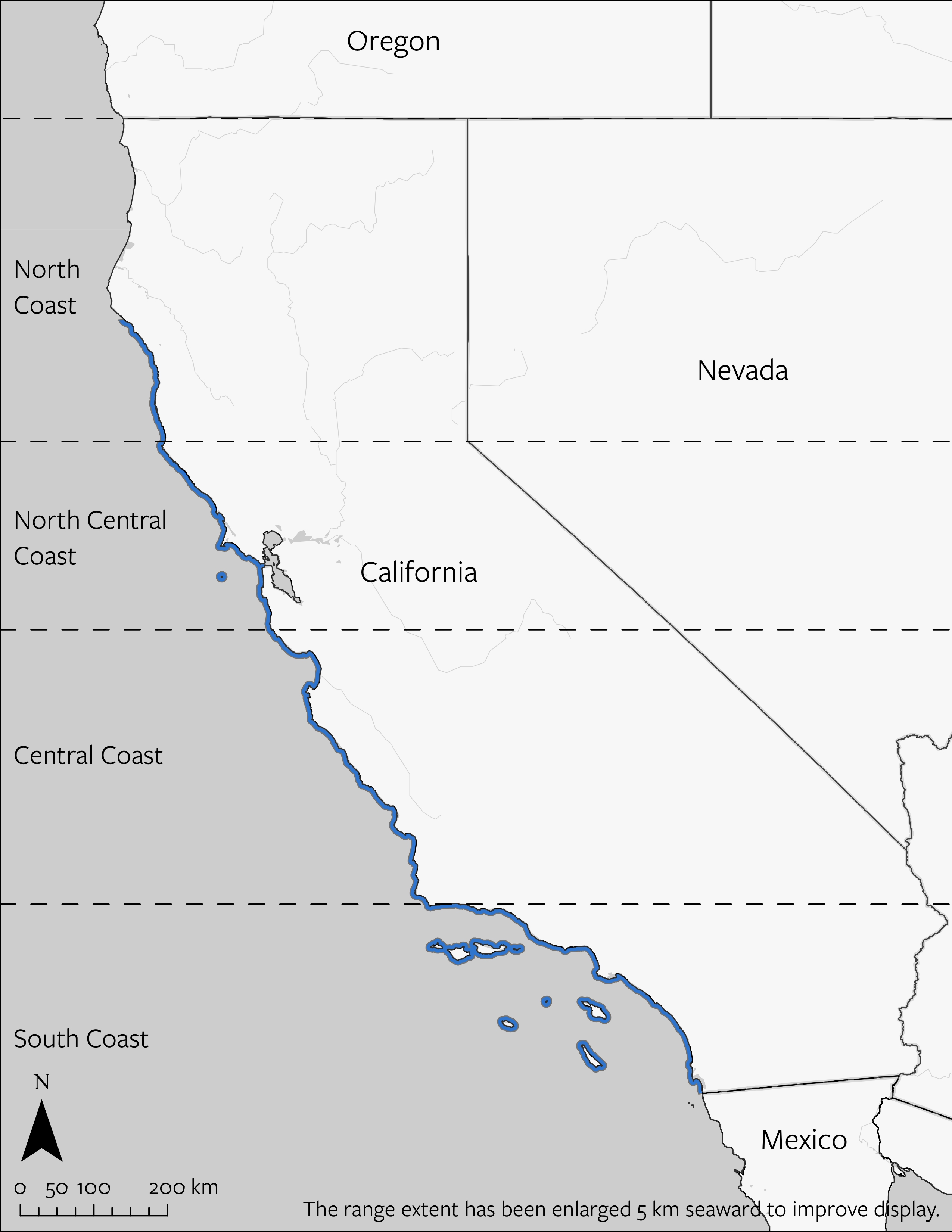
Owl limpets typically live in the mid-high intertidal zone on rocky shores of the Pacific Coast of North America, ranging from North Central California to Southern Baja.
Range Map
Reproductive biology and life history
Owl limpets are hermaphrodites, starting out as males and becoming females as they grow larger. Owl limpets typically spend two years as juveniles before they can begin producing sperm as males. Female owl limpets, however, may require much longer to reach reproductive maturity because limpets must grow to a certain size in order to switch from male to female. As a result, sexual maturity as females typically occurs several years after these limpets have functioned as males. It is worth noting that limpets will change sex earlier if harvest, for example, has depleted the number of females.
Ecology
Limpets are territorial, with individuals maintaining distinct areas that they clear by scraping rocks free of macro algae and newly settled invertebrates. These territories are described by ecologists as “farms”. The larger individuals will often bulldoze other competitors from rock surfaces, and thereby create space in their territories for the growth of the micro algae upon which they graze. Younger males that do not have their own territories sneak into farms and graze food as rapidly as possible before being bulldozed off. Owl limpets typically either live in patches in mussel habitat where they tend to be smaller due to limited space and thus food, or on open rock habitat, where they have large spaces to feed, and larger territories yield larger limpets.
Cultural and historical context
Owl limpets have been used by Native Americans for thousands of years as a food source and for fishing bait. They are sometimes referred to as “poor man’s abalone” and are today harvested for recreational purposes in some areas, although regulations exist to reduce risk of overharvest.
Date modified: January 2025
Primary ThreatsPrimary Threats Conditions
Threats and Conservation Status
Overall, limpet populations show a strong increasing trend (4% increase per year explaining 34% of the year-to-year variation). This increasing trend is seen in both the South Coast and Central Coast regions, with the Central Coast exhibiting the strongest increase (5.7% annual increase, explaining 57% of the between-year variation in owl limpet abundances). In addition, recent scientific publications have suggested increasing owl limpet abundances in Northern California, where owl limpets have traditionally been uncommon, are associated with a northward range expansion of these limpets linked to the 2014-2016 marine heatwave.
Although owl limpets are common on Southern and Central California rocky shores, they are at risk of being unsustainably harvested. In some regions recreational fishers can take up to 35 limpets per day. Since the largest limpets are preferred for harvest, their collection is biased towards removing the reproductive females, which can undermine reproductive success. Data show that this selective harvesting has led to a decrease in the average size of these limpets. Harvesting of owl limpets is prohibited in Marine Protected Areas – but even in these areas illegal harvest occurs.
Climate change could also impact owl limpets by increasing the likelihood of desiccation or overheating. Hot temperatures can damage muscle proteins and thereby reduce a limpet’s ability to adhere to the substrate. Heat also alters mucus properties in a way that interferes with adhesion. In spite of the physiological stresses owl limpets may experience with heat overloads, population data do not currently reveal an association between marine heat waves and population declines in owl limpets.
Population Plots
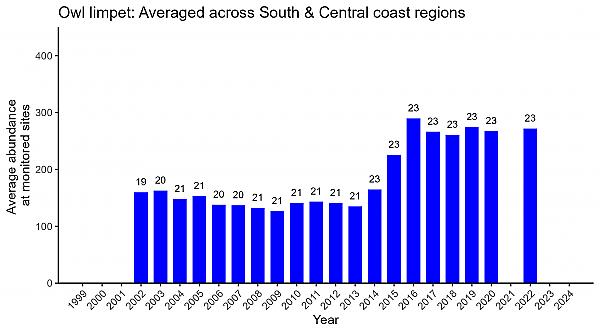
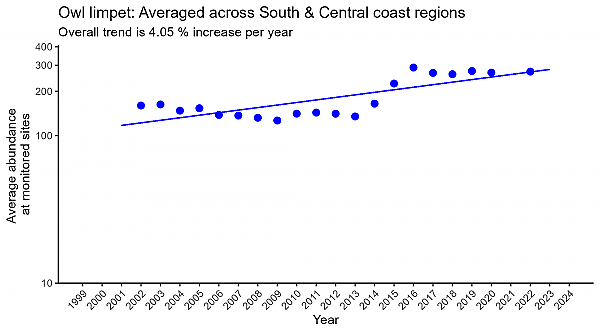

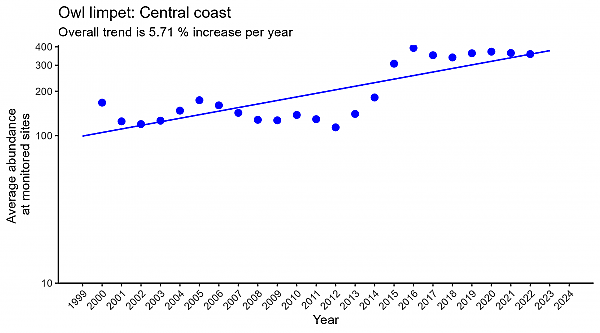
Data Source: The data were obtained from the rocky intertidal sampling locations that are part of MARINe (see https://marine.ucsc.edu/). The MARINe website describes the sampling protocol.
- Erlandson, J. M., Braje, T. J., Rick, T. C., Jew, N. P., Kennett, D. J., Dwyer, N., ... & Watts, J. (2011). 10,000 years of human predation and size changes in the owl limpet (Lottia gigantea) on San Miguel Island, California. Journal of Archaeological Science, 38(5), 1127-1134.
- Miller, L. P., Harley, C. D., & Denny, M. W. (2009). The role of temperature and desiccation stress in limiting the local‐scale distribution of the owl limpet, Lottia gigantea. Functional Ecology, 23(4), 756-767.
- Nielsen, E. S., Walkes, S., Sones, J. L., Fenberg, P. B., Paz‐García, D. A., Cameron, B. B., ... & Bay, R. A. (2024). Pushed waves, trailing edges, and extreme events: Eco‐evolutionary dynamics of a geographic range shift in the owl limpet, Lottia gigantea. Global Change Biology, 30(7), e17414.
- Sagarin, R. D., Ambrose, R. F., Becker, B. J., Engle, J. M., Kido, J., Lee, S. F., ... & Roe, C. (2007). Ecological impacts on the limpet Lottia gigantea populations: human pressure over a broad scale on island and mainland intertidal zones. Marine Biology, 150, 399-413.
- Sanford, E., Sones, J. L., García-Reyes, M., Goddard, J. H., & Largier, J. L. (2019). Widespread shifts in the coastal biota of northern California during the 2014–2016 marine heatwaves. Scientific reports, 9(1), 4216.
- Stimson, J. (1970). Territorial behavior of the owl limpet, Lottia gigantea. Ecology, 51(1), 113-118.