Great Blue Heron
Ardea herodias

Great Blue Heron
Ardea herodias
Despite habitat loss and sensitivity to other human disturbance, great blue heron populations are stable.
Morphology
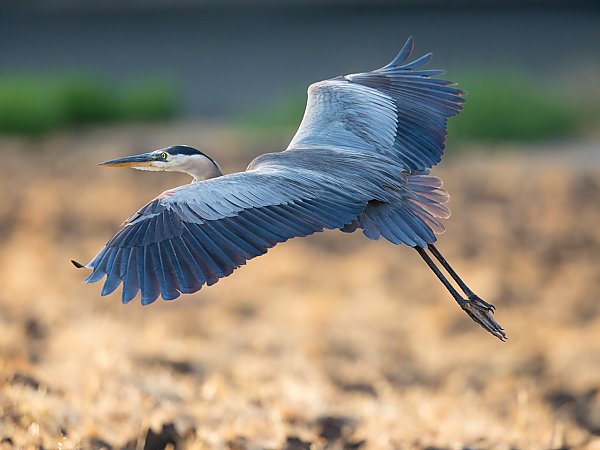
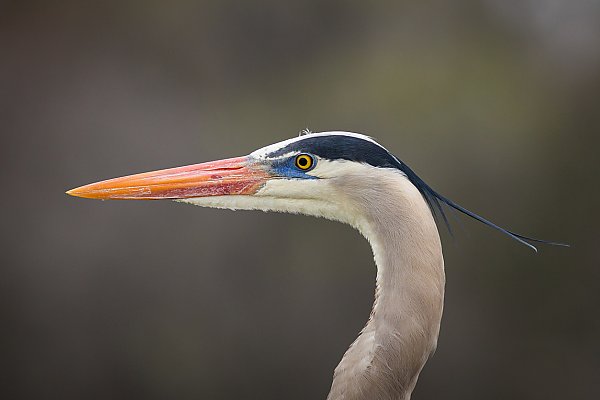
The Great Blue Heron is the largest heron in North America, standing at a little under one and a half meters tall, with a wingspan of up to two meters. They are distinguished by their long necks which they can coil into an “S-shape” for quick striking of fish in the water. This is made possible by specialized modifications of their neck vertebrae. Great Blue Herons also have specialized “powder down” feathers on their chest. They use this powder down like a washcloth, combing through it with their middle toes to remove fish slime and oils from their feathers while preening.
Habitat and Range
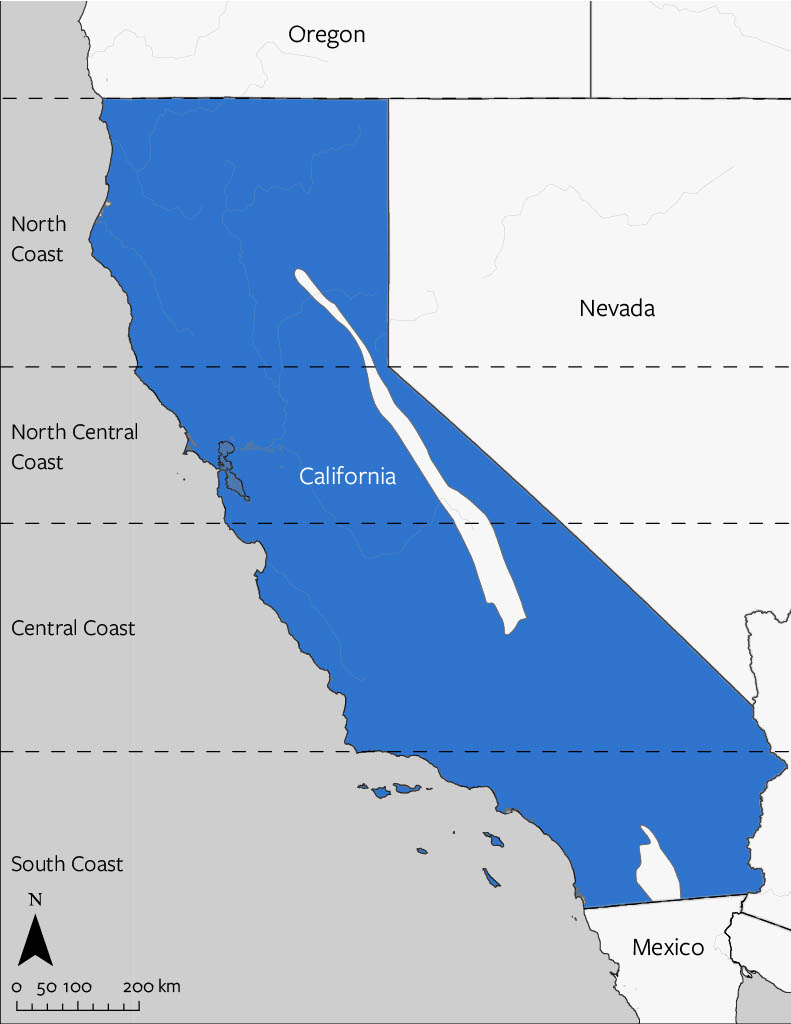
The Great Blue Heron has a wide range across North America. They are found throughout California, inhabiting a variety of wetland environments. They favor shallow estuaries and wetlands, and are found less frequently in riverine and rocky marine shores, croplands, and pastures. At lower elevations these birds can be found in areas with abundant water sources such as marshes, mudflats, and agricultural fields. They are also observed in higher elevations along river valleys.
Range Map
Reproductive Biology and Life History
Great Blue Herons typically breed in colonies known as heronries, which are often located in tall trees near water bodies. Nesting begins in February, with males selecting nesting sites and attracting females through displays. The nests are constructed high in trees and are made from sticks lined with softer materials. Females lay 2-6 pale blue eggs, which are incubated by both parents for 25-30 days. The chicks hatch asynchronously, and the parents continue to feed them for about two months until they can fly and for several weeks thereafter. Great Blue Herons become reproductively mature at age two and have been known to live up to 24 years, although an average lifespan is 15 years.
Ecology
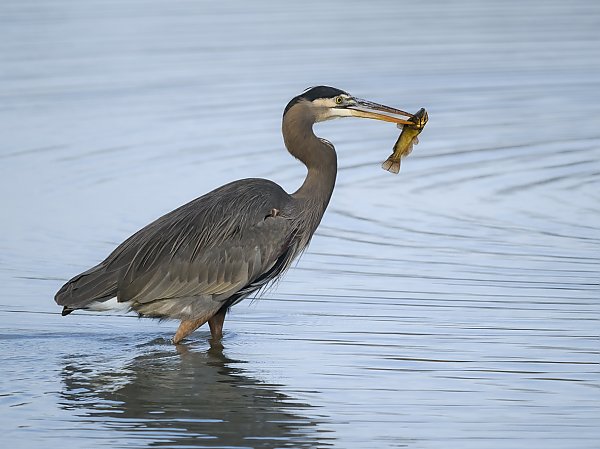
Great Blue Herons are wading birds that use their sharp bills to catch prey. The diet of the Great Blue Heron is diverse, though primarily focused on fish, which constitutes about 75% of their intake. They also consume small mammals, amphibians, reptiles, insects, and occasionally other birds. Herons employ a variety of hunting techniques, including standing still or walking slowly in shallow waters to catch prey with their long, sharp bills. Their excellent night vision allows them to hunt effectively both day and night.
Cultural and Historical Context
Many Native American tribes in California, including coastal groups, revered the Great Blue Heron as symbols of wisdom and good judgment, believed to bring good fortune, especially related to fishing.
In contrast to the sustainable relationship between Great Blue herons and Native Americans, European settlers over-exploited Great Blue Herons between 1840 and World War I. The birds were killed by the millions to satisfy the demand for feathers in women’s fashion, particularly for hat decorations. The demand for heron feathers was enormous: in 1903, plumes were worth $32 per ounce, about twice the price of gold at the time. In 1886 alone, an estimated 5 million birds were killed for their feathers. The founding of the Audubon Society in 1905 was partly in response to the devastating effects of the plume trade on waterbirds, including herons. Subsequently, the Audubon Society played a major role in educating the public about the cruel impacts of the feather trade, and eventually led to the demise of the feather market.
Date modified: January 2025
Primary ThreatsPrimary Threats Conditions
Threats and Conservation Status
With the killing of herons for their feathers no longer taking place, the Great Blue Heron population in California now appears to be stable. However, because herons function as top predators in aquatic ecosystems, they will always be prone to bioaccumulating toxins that have been transferred up the food chain. In addition, Great Blue Herons are sensitive to human disturbance, especially during nesting season. Expanding human populations can also lead to direct habitat loss when wetlands are drained for residential development. Even if a nesting area is protected, loud noises can cause herons to abandon their nests. Layered on top of these immediate threats is the uncertain impact of climate change. Ongoing monitoring and habitat protection will be key to ensuring the continued presence of Great Blue Herons in California’s diverse ecosystems.
Population Plots
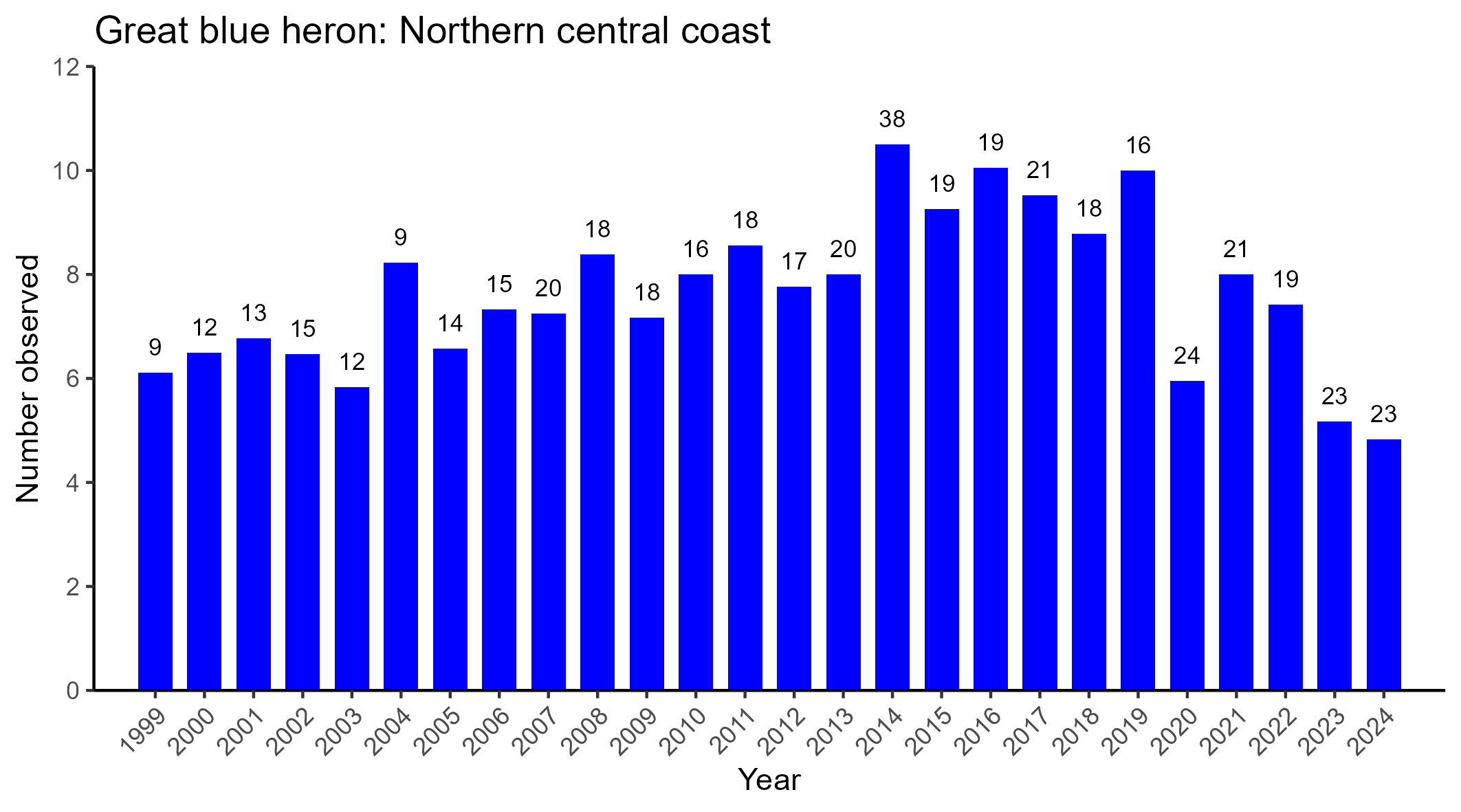
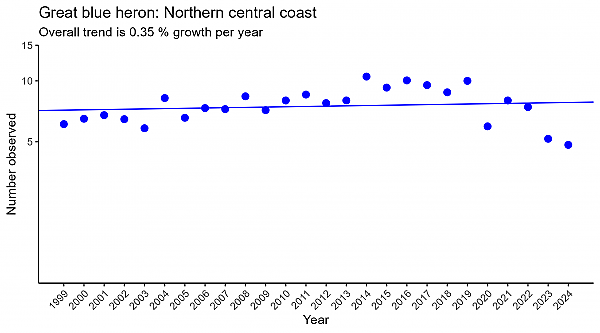
Data Source: San Francisco Bay Bird Observatory
- Bleitz, D. E. (1993). The prehistoric exploitation of marine mammals and birds at San Nicolas Island, California.
- Butler, R. W. (1997). The great blue heron: A natural history and ecology of a seashore sentinel. UBC Press.
- Buchanan, S. C. (1990). Habitat utilization by great blue herons (Ardea herodias) in Elkhorn Slough, California. San Jose State University.
- Hothem, R. L., Crayon, J. J., & Law, M. A. (2006). Effects of contaminants on reproductive success of aquatic birds nesting at Edwards Air Force Base, California. Archives of environmental contamination and toxicology, 51, 711-719.
- Kelly, J. P., Etienne, K., Strong, C., McCaustland, M., & Parkes, M. L. (2007). Status, trends, and implications for the conservation of heron and egret nesting colonies in the San Francisco Bay area. Waterbirds, 455-478.
- Lyon, S., & Wood, E. (2023). Modeling the Historical Bird Communities of the Los Angeles Basin. Mapping Los Angeles Landscape History: The Indigenous Landscape, 69.
- Seston, R. M., Zwiernik, M. J., Fredricks, T. B., Coefield, S. J., Tazelaar, D. L., Hamman, D. W., ... & Giesy, J. P. (2009). Utilizing the great blue heron (Ardea herodias) in ecological risk assessments of bioaccumulative contaminants. Environmental monitoring and assessment, 157, 199-210.
- Whitley, D. S., & Whitley, T. K. (2016). A land of vision and dreams. In Contemporary Issues in California Archaeology (pp. 255-271). Routledge.