Golden Rockweed
Silvetia compressa

Golden Rockweed
Silvetia compressa
Golden rockweed has suffered recent declines but restoration via transplantation of individuals offers hope of recovery.
Morphology
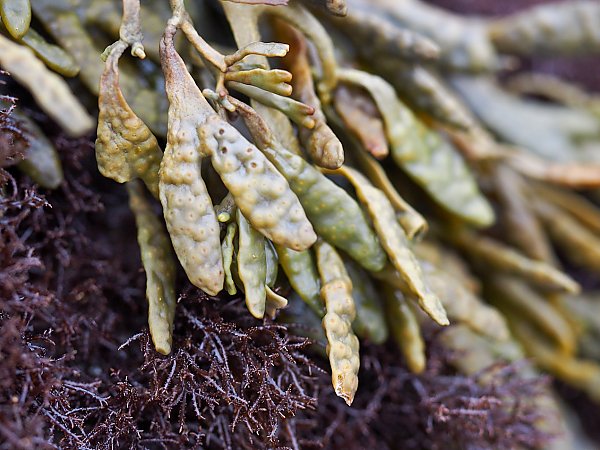
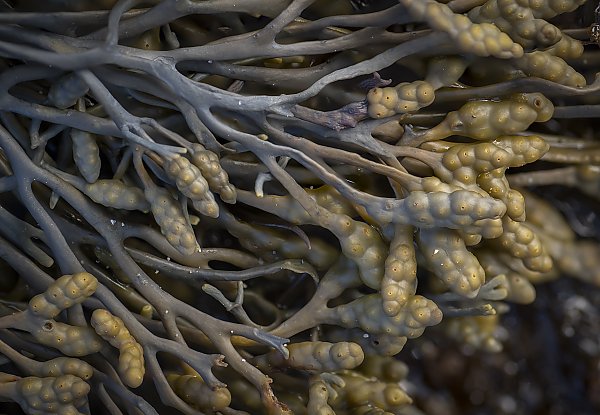
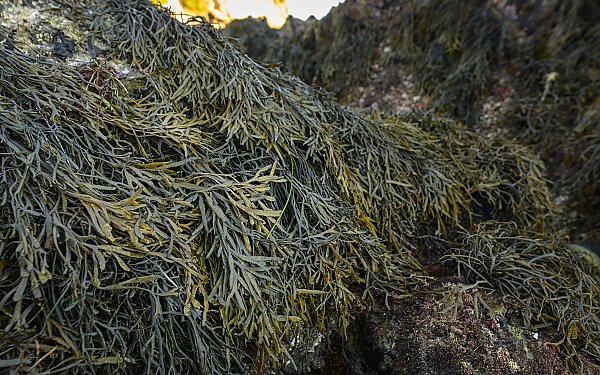
Golden rockweed grows in clumps of fronds that branch dichotomously. The fronds are olive green to yellowish-brown in color and have a tough, leathery texture. Rockweed typically grows up to 30 centimeters in length, although it can reach up to 90 centimeters under optimal conditions. This brown alga can grow in dense beds or as scattered individuals. Like other seaweeds, golden rockweed attaches to rocks or hard surfaces using a holdfast.
Habitat and Range
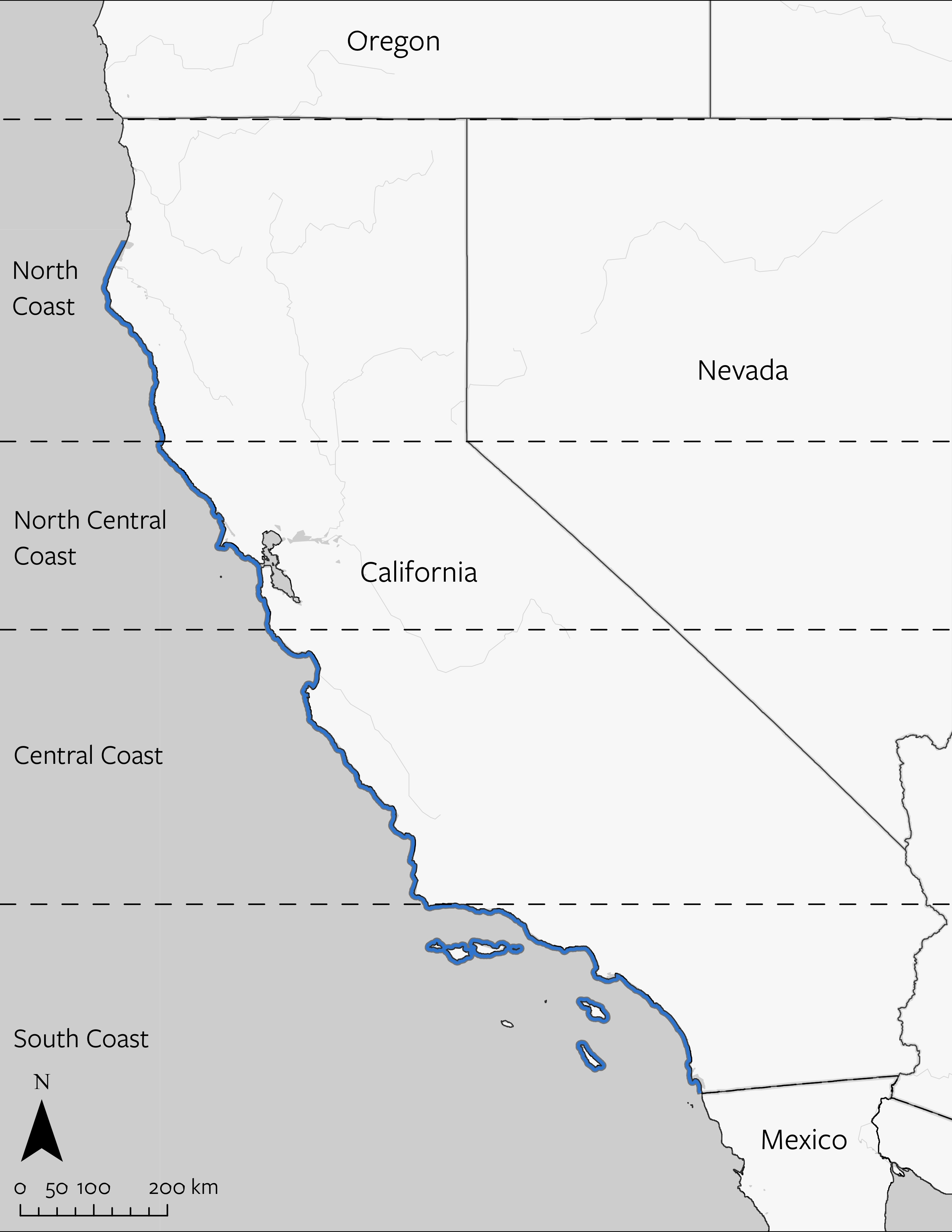
The range of Golden rockweed extends from Humboldt County, California, to northern Baja California, Mexico. The species does best in habitats with some protection from heavy surf.
Range Map
Reproductive Biology and Life History
Mature golden rockweeds produce sperm and eggs that are released throughout the tidal cycle, including during low tide. After fertilization, the embryos quickly settle and attach tenaciously to virtually any available surface. Recruitment of offspring typically occur close to the parent plant. Adult plants are known to live for eight years.
Ecology
Because golden rockweed forms dense canopies, it provides a moist microhabitat that offers protection from desiccation and temperature extremes. This canopy structure is essential for the survival of many intertidal species. It may also serve as an indicator of marine climate impacts because of its sensitivity to desiccation. The recent declines of rockweed populations are concerning because they could have cascading effects throughout various trophic levels in the intertidal ecosystem.
Cultural and Historical Context
Rockweed is considered a foundation species because it provides habitat for as many as 47 species of other algae and 64 invertebrate species. Unlike many other intertidal algae, there is no evidence that golden rockweed was significantly used by indigenous cultures.
Date modified: January 2025
This alga can be found at the Aquarium of the Pacific
Primary ThreatsPrimary Threats Conditions
Threats and Conservation Status
Golden rockweed faces several threats, including climate change, human disturbance, and oil spills. It is particularly susceptible to trampling. Extreme heat events and increased frequency of Santa Ana winds have also been linked to declines in rockweed populations. Averaging across the MARINe sites, rockweed is experiencing a 2.05% decline per year. When examined regionally, an annual decline between 2% and 3% holds for both the south and the central region. This results in the classification of a weak decline trend.
In order to counter local declines in rockweed, conservation efforts include translocating individuals from healthy populations to areas where populations have declined. Experiments have shown that transplanting rockweed can be successful, but this success can be diminished by desiccation. In particular, the greatest success transplanting rockweed in Southern California was achieved when larger individuals were transplanted onto partially shaded, north-facing vertical surfaces where desiccation is reduced.
Population Plots
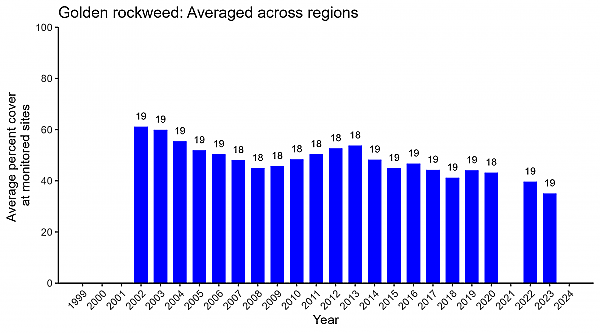
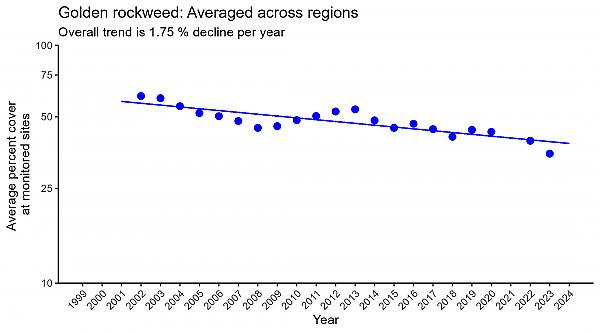
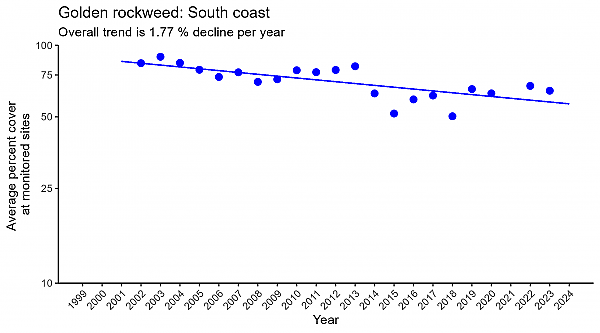
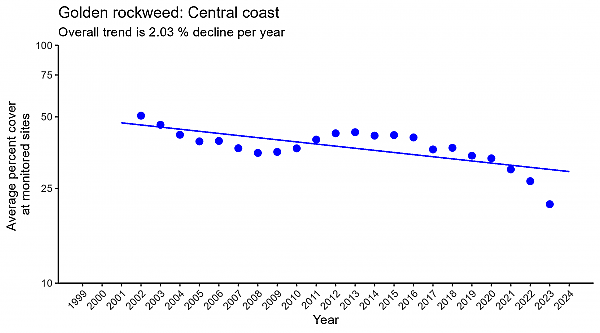
Data Source: The data were obtained from MARINe rocky intertidal sampling locations (see https://marine.ucsc.edu/). The MARINe website describes the sampling protocol.
- Graham, S., Hong, B., Mutschler, S., Saunders, B., & Bredvik, J. (2018). Changes in abundance of Silvetia compressa at San Clemente Island before and during the 2015–2016 El Niño. Western North American Naturalist, 78(4), 605-616.
- Gunnill, F. C. (1980). Demography of the intertidal brown alga Pelvetia fastigiata in southern California, USA. Marine Biology, 59, 169-179.
- Sapper, S. A., & Murray, S. N. (2003). Variation in structure of the subcanopy assemblage associated with southern California populations of the intertidal rockweed Silvetia compressa (Fucales). Pacific Science, 57(4), 433-462.
- Whitaker, S. G., Ambrose, R. F., Anderson, L. M., Fales, R. J., Smith, J. R., Sutton, S., & Miller, R. J. (2023). Ecological restoration using intertidal foundation species: Considerations and potential for rockweed restoration. Ecosphere, 14(3), e4411.
- Whitaker, S. G., Raimondi, P. T., Smith, J. R., Lenihan, H. S., Gaines, S. D., & Miller, R. J. (2024). Decline of a North American rocky intertidal foundation species linked to extreme dry, downslope Santa Ana winds. Frontiers in Ecology and Evolution, 12, 1291310.
- Whitaker, S. G., Smith, J. R., & Murray, S. N. (2010). Reestablishment of the southern California rocky intertidal brown alga, Silvetia compressa: an experimental investigation of techniques and abiotic and biotic factors that affect restoration success. Restoration Ecology, 18, 18-26.