Garibaldi
Hypsypops rubicundus

Garibaldi
Hypsypops rubicundus
Populations of the state's official marine fish, Garibaldi, are stable, but warming ocean temperatures may impact their future.
Morphology
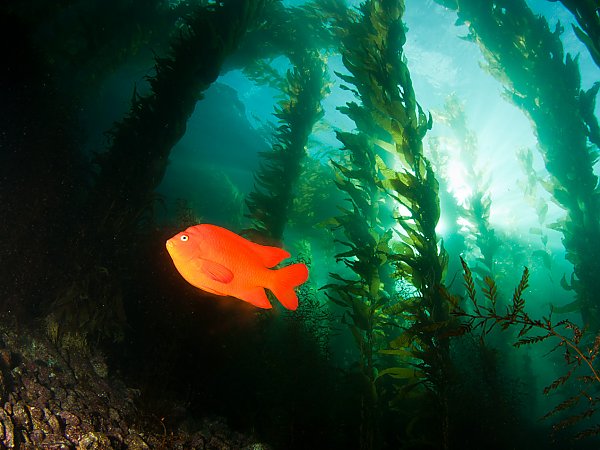
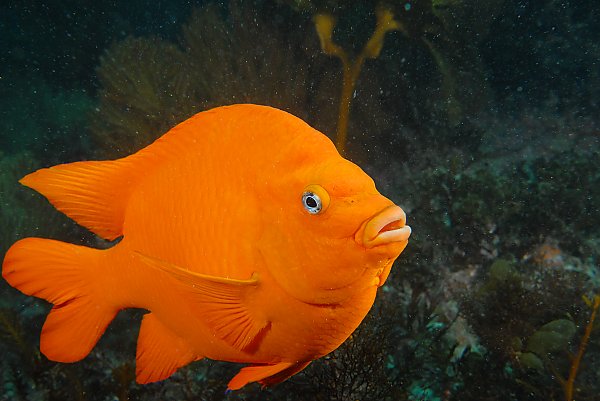
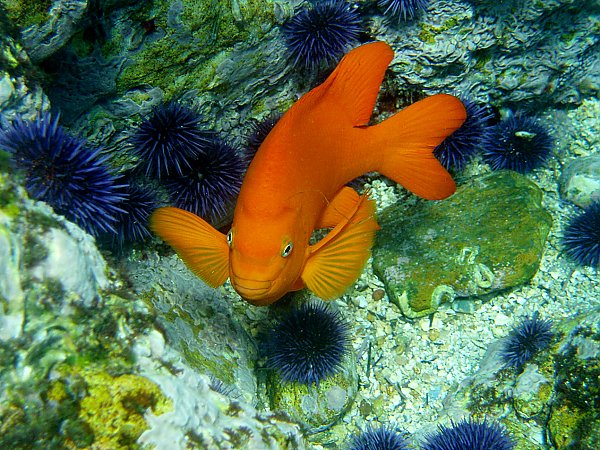
Garibaldi are bright orange fish reaching lengths of up to 38 centimeters when fully grown. Juveniles are reddish-orange with iridescent blue spots that disappear as they mature. They have an oval-shaped, laterally compressed body and a heart-shaped tail fin.
Habitat and Range
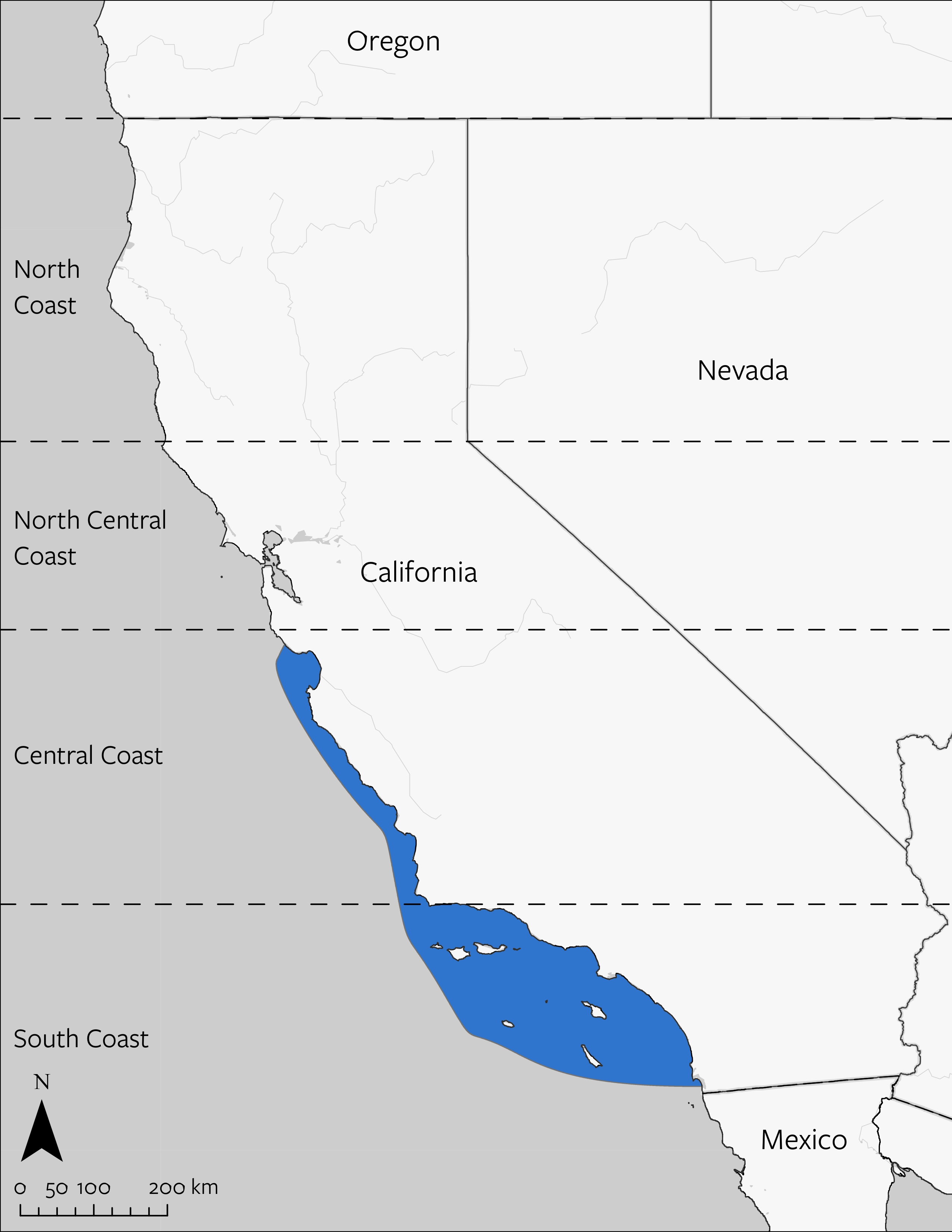
Garibaldi are found along the Eastern Pacific Coast, with their range extending from Baja California to Monterey Bay. These fish primarily inhabit coastal rocky reefs and kelp forests where they find shelter from predators and feeding opportunities. The ocean facing sides of harbor breakwaters made from quarry rock are also particularly good Garibaldi habitats and they can be found there in high densities. Although they are observed at depths up to 30 meters, Garibaldi are usually found at depths less than 14 meters.
Range Map
Reproductive Biology and Life History
Garibaldi can live at least 57 years, with lifespans of 20 to 30 years being relatively common. They reach sexual maturity at 5-6 years of age, with males usually maturing slightly earlier than females.
Garibaldi are highly territorial. Each spring, Garibaldi males begin establishing spawning areas in their territories by cultivating specific red algae species and removing debris, a process that can take up to a month. During the spawning season (March to July), males attempt to attract females with loud clucking sounds and swimming displays. Females are highly selective, inspecting the nest before deciding to mate. If a female approves, she lays 15,000 to 80,000 bright yellow eggs in the nest. The male then fertilizes the eggs externally. After fertilization, the male immediately chases the female away to prevent egg predation. He then guards the nest aggressively, fanning and grooming the eggs. Several females may deposit eggs in the same nest, and a single female may lay eggs in multiple nests.
Ecology
Garibaldi are omnivorous, with a diet primarily consisting of worms, anemones, sponges and bryozoans. They are most active feeding within and defending their territories during the day and sheltering between rocks at night. When disturbed, Garibaldi can produce a thumping or clacking noise which serves as a warning to potential threats. Common predators of Garibaldi include sharks, kelp bass, sea lions, seals, bald eagles, and pelicans.
Cultural and historical context
Historically, the Garibaldi was never a significant commercial fishery in the traditional sense. However, its striking orange coloration and territorial nature made it a popular target for aquarium hobbyists. From 1953 to 1995, there was a limited commercial take of Garibaldi allowed, even though recreational take was prohibited. This commercial harvest depleted the population and eventually led to legislation that ended all commercial take of Garibaldi. Today, removing a Garibaldi from California waters requires a special permit from the California Department of Fish and Wildlife, not just a standard fishing license. This strict protection has helped stabilize Garibaldi populations along the California coast.
Date modified: October 2025
This animal can be found at the Aquarium of the Pacific
Primary ThreatsPrimary Threats Conditions
Threats and Conservation Status
California’s population of Garibaldi is stable with fluctuations, as can be seen in the survey data from 1999 onward. Although there is a slight trend of increasing population from a low in 2010, the overall trend line explains so little of the variation in abundance (7%) that “stable with fluctuations” is an appropriate label. While the population trends for Garibaldi are favorable, experience indicates that overfishing is always a risk. In addition, ocean deterioration such as habitat degradation due to development and pollution could imperil these dazzling fish in the future. Studies have also indicated that Garibaldi are larger and live longer in cooler locations than in warmer locations, which suggests that a warming ocean may eventually depress Garibaldi populations or force a shift in their distribution as they move towards cooler waters. But, as of now, Garibaldi are maintaining a healthy population in Southern California.
Population Plots
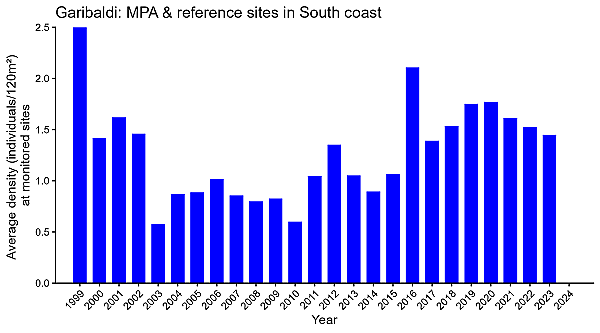

Data Source: Monitoring and Evaluation of Kelp Forest Ecosystems in the MLPA Marine Protected Area Network. California Ocean Protection Council Data Repository.
- Calderon, B. E. F., Eagleton, J. L., Williams, C. M., & Claisse, J. T. (2024). Garibaldi (Hypsypops rubicundus) from artificial reefs and cooler island natural reefs consume more animal material, which is associated with greater adult size and body condition. Journal of Experimental Marine Biology and Ecology, 580, 152048.
- Clarke, T. A. (1970). Territorial behavior and population dynamics of a pomacentrid fish, the Garibaldi, Hypsypops rubicunda. Ecological monographs, 40(2), 189-212.
- Johnson, T. D., Barnett, A. M., DeMartini, E. E., Craft, L. L., Ambrose, R. F., & Purcell, L. J. (1994). Fish production and habitat utilization on a southern California artificial reef. Bulletin of Marine Science, 55(2-3), 709-723.
- Mearns, A. J., Bissell, M., Morrison, A. M., Rempel‐Hester, M. A., Arthur, C., & Rutherford, N. (2019). Effects of pollution on marine organisms. Water Environment Research, 91(10), 1229-1252.
- Williams, C. M., J. L. Eagleton, D. J. Pondella and J. T. Claisse (2022). "Habitat type and environmental conditions influence the age and growth of a temperate marine damselfish." Frontiers in Marine Science, 9.