California Least Tern
Sterna antillarum browni

California Least Tern
Sterna antillarum browni
Conservation efforts have spared the species from extinction; however, the species remains at risk due to its concentrated breeding sites and sensitivity to human disturbance.
Morphology
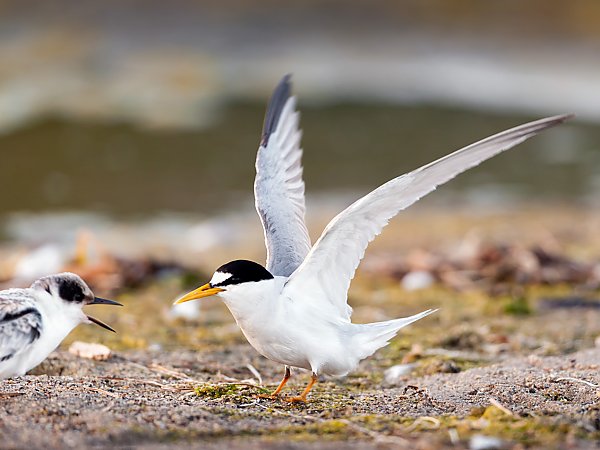
The California Least Tern is a migratory seabird that is the smallest of North American terns, measuring about 21-23 centimeters in length with a wingspan of 48-53 centimeters. They weigh between 36 and 54 grams. Adults have a small, sleek white body with a pale gray back and wings, and a mostly yellow bill, often with a black tip.
Habitat and Range
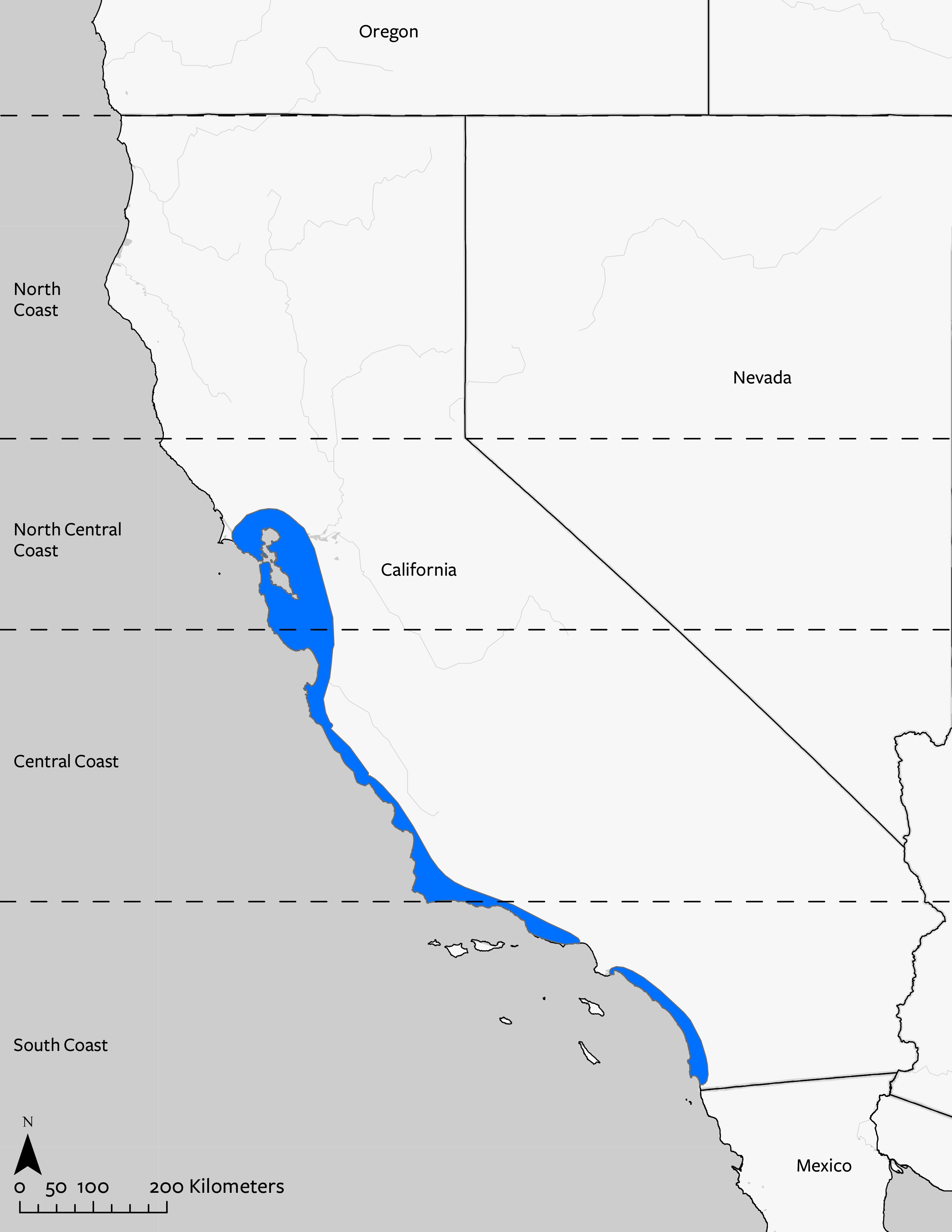
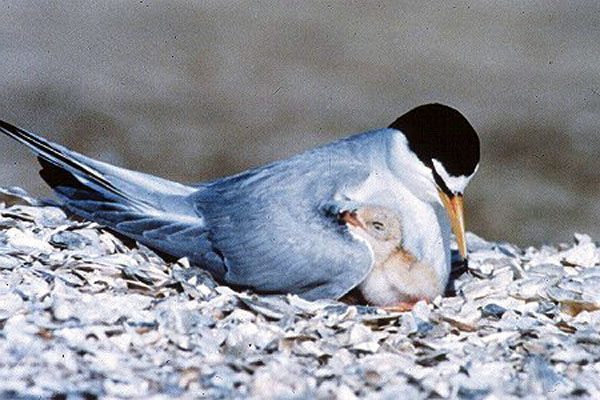
The California Least Tern typically nests on open, sandy beaches, mudflats, and sand dunes. They prefer areas with sparse vegetation near lagoons, estuaries, and bays. The nests are simple, shallow depressions in the ground, often decorated with pebbles or shells. Adults roost on the ground in unprotected coastal areas, often near their nesting sites. The California Least Tern breeds along the Pacific coast of California, from San Francisco Bay to Baja California, Mexico, although in recent years there are occasional reports from interior sites like the Central Valley of California and even in Arizona. Key breeding areas in California include San Francisco Bay, Sacramento River Delta, coastal regions from San Luis Obispo County to San Diego County, and notable sites such as Seal Beach, San Pedro Bay, Camp Pendleton, and Ballona Creek. They are a migratory species with no interlap over breeding and wintering ranges. Wintering locations, while still largely unknown, ranges between Central and South America.
Range Map
Reproductive Biology and Life History
California Least Terns start breeding when about three years old. They are seasonally monogamous, forming pair bonds for one breeding season. They nest in loose colonies of usually 25-50 pairs. Clutch size is typically 2-3 eggs, with both parents incubating the eggs for about 3-4 weeks. Fledglings leave the colony at 4-5 weeks old but continue to be fed by parents for another 2 weeks. During the breeding season, males engage in courtship feeding, where they catch small fish and present them to females as part of their mating ritual. This behavior helps strengthen pair bonds and provides the female with additional nutrition. The longevity of least terns is estimated to be between 15 and 20 years based on bird banding studies.
Ecology
California Least Terns are known for their distinctive foraging behavior. They hover over water with rapid wingbeats before diving beak-first to catch small fish just below the surface. This technique is often described as resembling a miniature fighter plane or tiny bomber. The primary diet of the California Least Tern includes small fish such as anchovies, silversides, and juvenile rockfish. These fish forage in shallow estuaries, lagoons, and nearshore waters. Because they nest on the ground, least terns are easy prey for terrestrial mammals such as foxes, raccoons, and coyotes, as well as dogs and cats.
Cultural and Historical Context
The California Least Tern suffered severe population declines in the late 1800s, when they were hunted for their feathers, which were used in the fashion industry for decorating hats. The passage of the Migratory Bird Treaty Act in 1918 helped protect the species from hunting. Despite these protections, the species continued to struggle due to habitat loss and disturbances, leading to its listing as endangered under the Endangered Species Act in 1970 and by the State of California in 1984.
Date modified: January 2025
Primary ThreatsPrimary Threats Conditions
Threats and Conservation Status
Conservation efforts have led to population increases in least terns from a low of about 600 breeding pairs in California to over 6,000 pairs now. However, the species remains at risk due to its concentrated breeding sites, its susceptibility to predators, sensitivity to human disturbance, and declines in local food availability. Conservation efforts include habitat restoration, predator control, and public education to protect nesting sites. These measures are crucial as habitat loss due to urban development continues to threaten the species.
California Least Terns appear to be experiencing a 5% annual decline when data are aggregated across the state and a piecewise regression is used to examine the trend. But there are regional differences. The overall decline exhibited by combining the regions, is driven largely by a nearly 6% annual decline in the South Coast region, the region where most of the terns occur. The Central Coast shows a slight increase, and the North Central Coast shows a slight decrease. The relatively steep decline in the South Coast tern sightings since 2005 warrants monitoring and attention because this is the region with the largest nesting population of terns. The cause of this decline is not known. Legacy pollutants such as mercury still show up in least tern populations near human population centers. Meanwhile the restriction of human activity near tern breeding sites remains challenging because of heavy human presence along our coastline.
Population Plots


Data Source: California Department of Fish and Wildlife and Point Blue Conservation Science
- Baird, P. (2023). Group Adherence in Endangered California Least Terns (Sternula antillarum browni). Waterbirds, 45(4). https://doi.org/10.1675/063.045.0410
- Clatterbuck, C. A., Lewison, R. L., Dodder, N. G., Zeeman, C., & Schiff, K. (2018). Seabirds as regional biomonitors of legacy toxicants on an urbanized coastline. Science of the total environment, 619, 460-469.
- ECOS. (2024, May 16). Species Profile: California Least Tern. Environmental Conservation Online System. https://ecos.fws.gov/ecp/species/8104
- Feeney, L. (2000). California Least Tern. Species and Community Profiles, 359-362.
- Jauregui, C., Realegueno, J., Ryan, T., & Vigallon, S. Breeding Biology of the California Least Tern at Venice Beach, Marina Del Rey, California in the 2016 Breeding Season. Report to the State of California Department of Fish and Wildlife.
- Lafferty, K. D. (2001). Birds at a Southern California beach: seasonality, habitat use and disturbance by human activity. Biodiversity & Conservation, 10, 1949-1962.
- Leicht, A. G., Robinette, D. P., Elliott, M. L., & Horn, M. H. (2023). Comparison of Diets in the California Least Tern (Sternula antillarum browni) at Two Sites in Central California, U.S.A. Waterbirds, 46(1–2). https://doi.org/10.1675/063.046.0109
- Massey, B. W., Bradley, D. W., & Atwood, J. L. (1992). Demography of a California Least Tern Colony including Effects of the 1982-1983 El Niño. The Condor, 94(4), 976–983. https://doi.org/10.2307/1369293
- Palestis, B. G. (2014). The role of behavior in tern conservation. Current Zoology, 60(4), 500-514.
- Thompson, B. C., J. A. Jackson, J. Burger, L. A. Hill, E. M. Kirsch, and J. L. Atwood (2020). Least Tern (Sternula antillarum), version 1.0. In Birds of the World (A. F. Poole and F. B. Gill, Editors). Cornell Lab of Ornithology, Ithaca, NY, USA. https://d
- U.S. Fish and Wildlife Service. 2020. California least tern (Sternula antillarum browni) 5-year Review: 2020 Summary and Evaluation. Carlsbad Fish and Wildlife Office, Carlsbad, CA. 120 pp.
- U.S. Fish & Wildlife Service. (2023, July 31). Sterna antillarum browni. FWS.gov. https://www.fws.gov/species/california-least-tern-sterna-antillarum-browni