California Brown Pelican
Pelecanus occidentalis

California Brown Pelican
Pelecanus occidentalis
California brown pelicans are a conservation success story and were delisted in 2009 after 37 years on the Endangered Species list.
Morphology
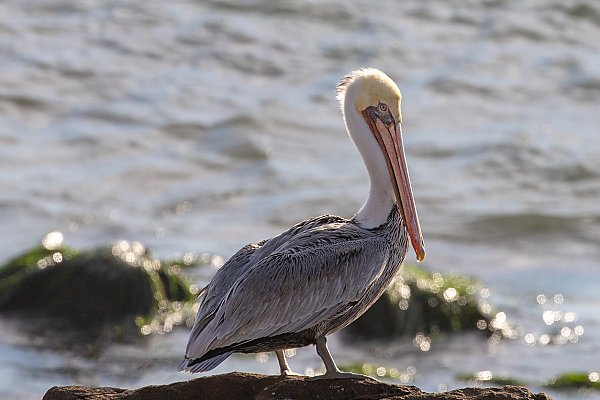
The California brown pelican is a distinctive large seabird that glides above the surf. These impressive fishers plunge-dive from high up to feed, with the depth and angle of each dive potentially determining the capture rate. They have a wingspan of about 2 meters and weigh between 3 and 5 kilograms. One of the most prominent features of the brown pelican is its long, dark bill with a large gular pouch that is expandable. This pouch is made of stretchy, featherless skin that hangs from the lower jaw. It acts like a fishing net, enabling the pelican to scoop up fish along with up to several gallons of water during feeding. Because they are plunge divers, they are thought to have no exposed external nares (or nostrils); however, they actually have thin slits for nares along the ridges of the upper bill nearer the eyes. Although these slits are not large enough to move much air for breathing, they allow the pressure within the sinuses to equalize and allow concentrated salt solution to drain from the salt glands. Another unusual characteristic of pelicans is their skin, which bears a striking resemblance to internal bubble wrap. It is filled with scores of small air pockets that provide buoyancy with the results that pelicans tend to be larger in dimensions than one might expect from their weight.
Habitat and Range
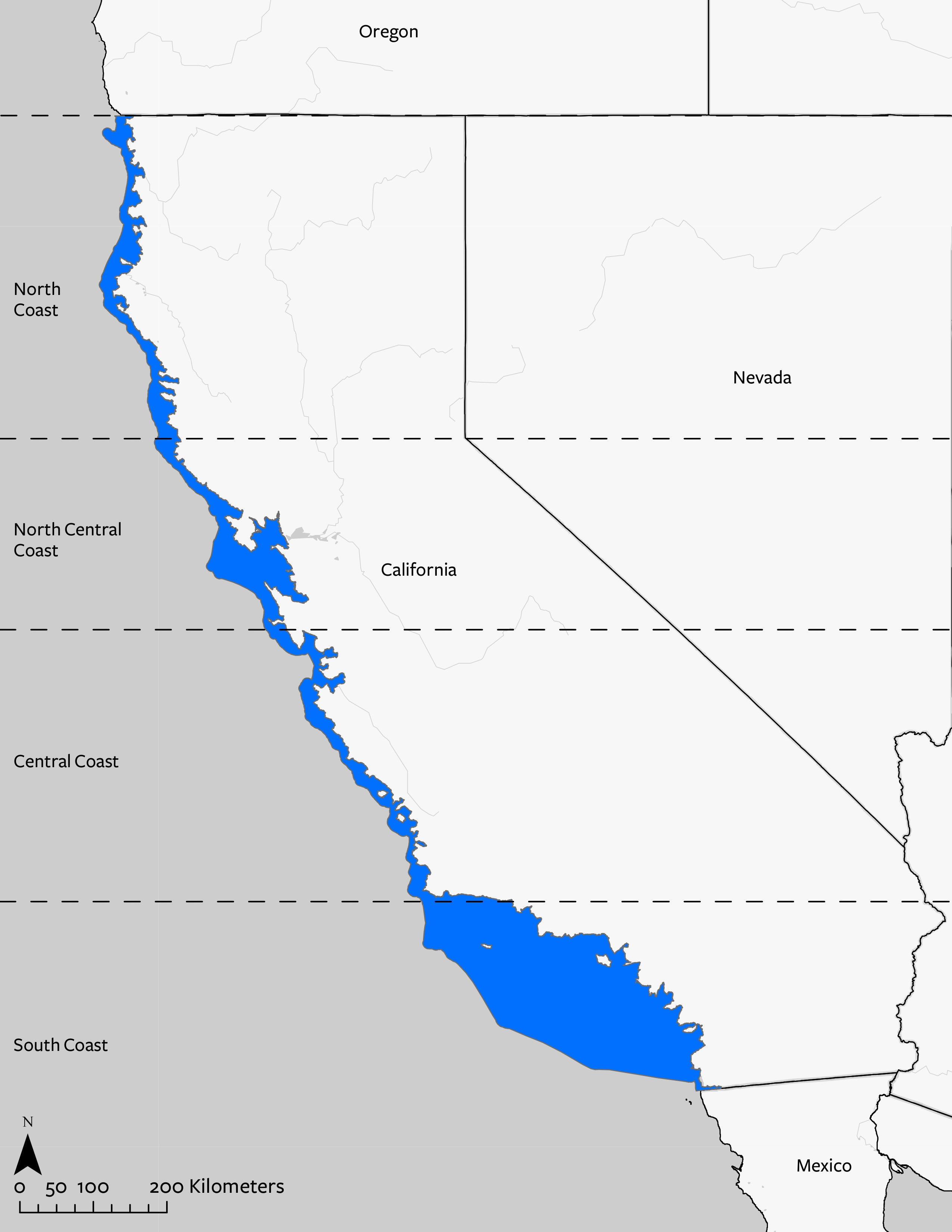
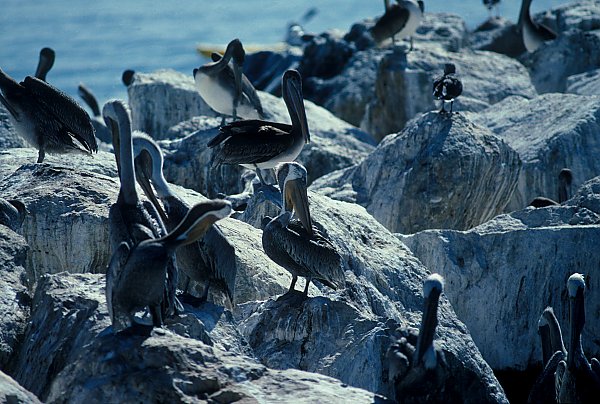
Brown pelicans are found on the Atlantic and Pacific coasts of North and South America in nearshore and estuarine habitats. The California subspecies’ range extends from British Columbia to Nayarit, Mexico; breeding takes place in colonies in Mexico and on the Southern California Channel Islands. Brown pelicans require dry land to maintain their plumage, so seldom venture more than 30 kilometers from the coast. They roost on islands, nearshore rocks, cliffs, piers, jetties, sandy beaches, and mudflats. Some traditional communal roosts support several thousand birds each night during the migratory period.
Range Map
Reproductive Biology and Life History
Brown pelicans typically live for more than a decade, with some individuals known to live up to 43 years in the wild. Their average age at first reproduction is between 3 and 4 years, with clutch sizes of 2 to 3 eggs per nest. Brown pelicans engage in a distinctive courtship process where the male selects a nesting site and attempts to attract a female through display behaviors. Once a female chooses a male, he brings her materials such as sticks, reeds, and grass for the nest construction. The female weaves these materials into the nest, which can be located on the ground, in a tree, or in a bush. The construction of the nest can take over a week.
Ecology
Pelicans feed mainly on surface schooling bait fish. However, they are opportunistic feeders and may also consume amphibians, crustaceans, offal and occasionally small birds and mammals. Pelicans are social birds, often seen flying in formation or resting in large groups. They breed in colonies, which can consist of hundreds of pairs. Communication within colonies involves visual displays and vocalizations. Pelicans are strong fliers, using thermals to soar and glide over long distances. The V formations they fly in, is a strategy which many large birds use to conserve energy. Each bird in the V formation flies slightly above the bird in front of it, which reduces wind resistance. This positioning allows the trailing birds to take advantage of the upwash created by the wings of the bird ahead, effectively reducing the energy needed to maintain flight. Studies have shown that birds flying in a V formation have lower heart rates compared to those flying alone. By reducing the energy demands of flight through gliding and V-formation flying, pelicans are able to increase the distance they can travel to find food.
Cultural and Historical Context
The California brown pelican is a notable example of successful conservation. In the 1960s and 1970s, the species faced severe declines due to pesticide use, particularly DDT, which caused eggshell thinning and reduced reproductive success. Conservation actions, including the banning of DDT in 1972 and legal protections under the Endangered Species Act, led to a remarkable recovery. By 2009, the brown pelican was removed from the list of endangered species. The plight of the brown pelican was instrumental in the establishment of the U.S. National Wildlife Refuge System in 1903, aimed at protecting water birds from bird feather hunters.
Date modified: April 2026
Primary ThreatsPrimary Threats Conditions
Threats and Conservation Status
Pelicans in California are monitored through annual surveys at nesting sites – most notably Anacapa and Santa Barbara Islands in the Channel Islands National Park. We show below the nest attempt data for these two island breeding locations lumped together.
Although the annual population growth rate from 1999 onward is estimated to be ~2%, the trend line explains so little of the year-to-year variation(< 5%) in number of nest attempts that the population is best classified as stable with fluctuations. Despite recovery from its endangered status, the brown pelican continues to face environmental challenges, including coastal development and human disturbance that causes loss of roosting sites, pollution, and fishing gear entanglement. In addition, overfishing and climate change-related factors have led to reduced populations of anchovies and sardines, which are crucial to the pelicans’ diet. Continued monitoring and management are necessary to ensure the species remains secure.
Population Plots
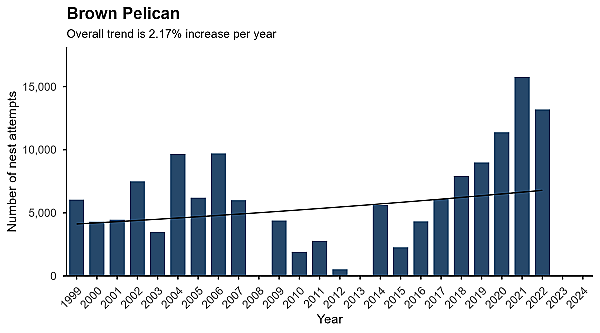
Data Source: California Institute of Environmental Studies and National Park Service, special thanks to Michael Parker and David Mazurkiewicz.
- *Anderson, D. W. (1988). In my experience: dose-response relationship between human disturbance and Brown Pelican breeding success. Wildlife Society Bulletin (1973-2006), 16(3), 339-345.
- Anderson, D. W., & Keith, J. O. (1980). The human influence on seabird nesting success: conservation implications. Biological Conservation, 18(1), 65-80.
- Briggs, K. T., Tyler, W. B., Lewis, D. B., Kelly, P. R., & Croll, D. A. (1983). Brown Pelicans in central and northern California. Journal of Field Ornithology, 54(4), 353-373.
- Croll, D. A., Ballance, L. T., Würsig, B. G., & Tyler, W. B. (1986). Movements and daily activity patterns of a Brown Pelican in central California. Condor, 258-260.
- Schreiber, R. W., & Risebrough, R. W. (1972). Studies of the brown pelican. The Wilson Bulletin, 119-135.
- Shoop, W., & Tilson, E. (2022). Plunge diving by brown pelicans resembles a split-S turn. Journal of Field Ornithology, 93(1).
- Velarde, E., Ezcurra, E., & Anderson, D. W. (2015). Seabird diet predicts following-season commercial catch of Gulf of California Pacific sardine and northern anchovy. Journal of Marine Systems, 146, 82-88.
- Wasser, D. E., & Sherman, P. W. (2010). Avian longevities and their interpretation under evolutionary theories of senescence. Journal of Zoology, 280(2), 103-155.
- Weimerskirch, H., Martin, H., Clerquin, Y., Alexandre, P., Jiraskova, S. (2001). Energy saving in flight formation. Nature, 413, 697-698